NYC homeowner guide
Drywall and Insulation in NYC
Drywall and insulation sit on the same wall but they are different jobs. A patch is mostly a question of damage and finish, with a lead-paint rule hiding in older buildings. Insulation is a question of foam type and fire code, with a NYSERDA incentive most people never check. Which one you have changes what a fair price looks like and what to ask before you sign.
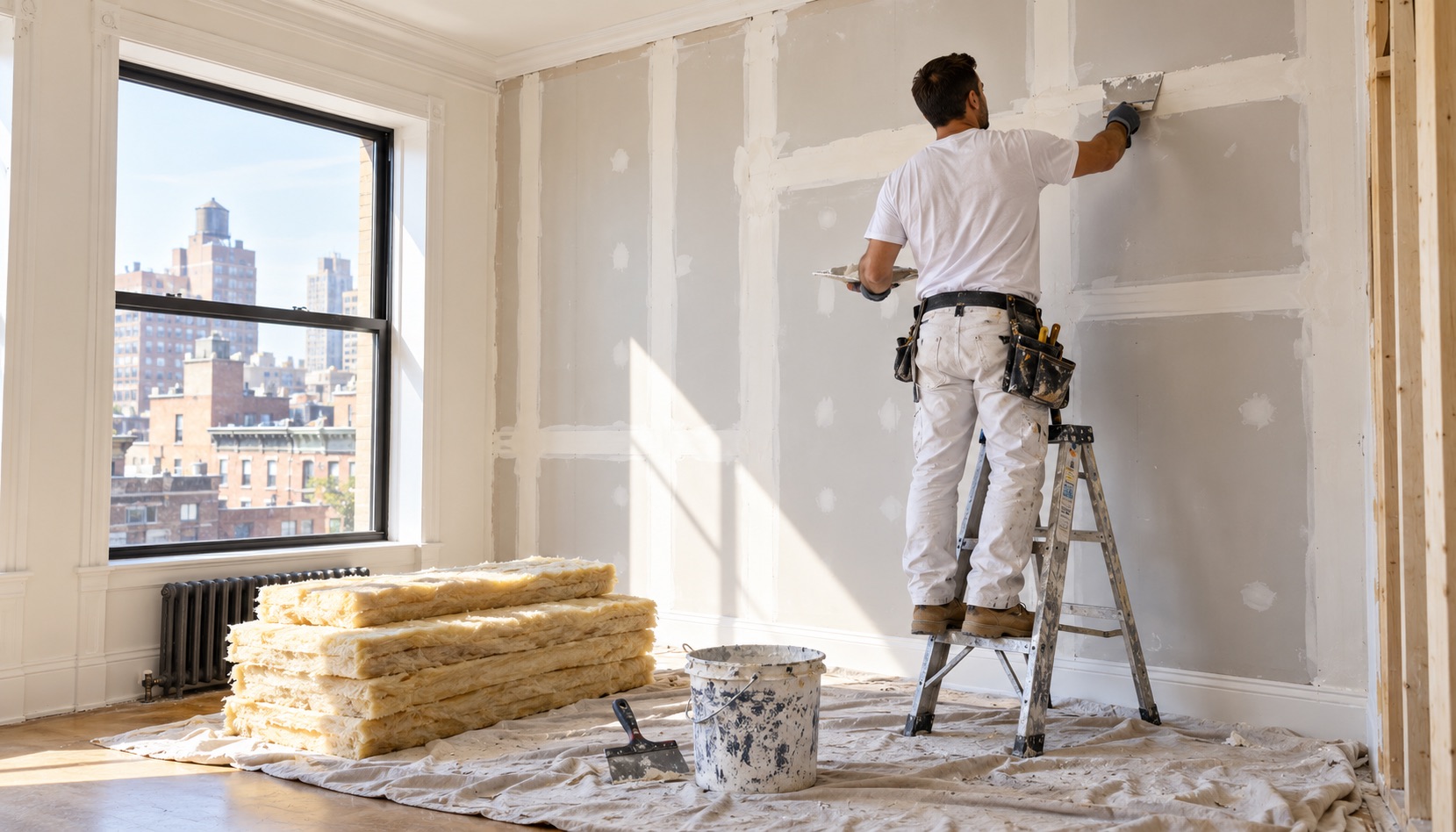
Quick Takeaways
- Drywall repair in NYC commonly runs $20 to $150 for small holes and dents, $50 to $400 for larger holes, cracks and seams, and $600 to $1,550 for water damage. A full room of new drywall runs about $300 to $3,900. These are external ranges from national cost-data aggregators and HomeGuide (reviewed August 2026), not our own benchmark.
- Spray foam insulation commonly runs $1.50 to $3.00 per sq ft for open-cell and $1.75 to $4.50 per sq ft for closed-cell. A NYC-specific average project in the data we reviewed ran $1,463 to $2,926.
- In a building constructed before 1978, the EPA's lead-safe rule can decide who may do a drywall job. For paid work that disturbs painted surfaces, the EPA requires the renovation firm to be certified and a certified renovator to be assigned to the job, unless it is minor repair and maintenance, which the regulation defines as 6 square feet or less of painted surface per room indoors and excludes if it involves window replacement or demolition of a painted surface.
- NYC has its own, separate lead rule with its own coverage list, mostly older rental housing: multiple dwellings built before 1960, certain 1960 to 1978 multiple dwellings where the owner knows lead paint is present, tenant-occupied one- and two-family homes built before 1960, and co-op or condo units not occupied by the owner or a family member. Repairs must follow federal and city rules, including certified firms or workers using safe work practices.
- Spray foam is foam plastic insulation, and the 2022 NYC Building Code (Section 2603.4) generally requires it to be separated from a building's interior by an approved thermal barrier such as 1/2-inch gypsum board. Attics and crawl spaces accessed only for utility service have a separate, lighter protection rule.
- NYSERDA's Comfort Home Program lists $2,500 (Good) and $3,000 (Better) incentives for sealing and insulating, plus a $2,000 windows add-on. Ask about it before you collect quotes, and confirm current terms on the program page.
- A Home Improvement Contractor license is required for home improvement work totaling more than $200, and the city lists drywall removal or repair as covered work. Check the license before you sign.
Which wall job do you actually have?
A hole where a shelf let go, a stain that appeared after a leak, and a cold bedroom wall that eats your heating bill all end up in the same conversation with a contractor, but they are priced and regulated very differently. This guide covers both drywall and insulation. The order matters: first what kind of job you have, then the rules that can apply, then what it should cost.
If you are patching or replacing drywall, the repair guide below has the damage-by-damage price breakdown and the lead-paint rule in full. If you are insulating an attic, wall or roof deck, the spray foam guide below covers open-cell versus closed-cell, the NYSERDA incentive and the fire-code rule.
What kind of job are you pricing?
Comparing two quotes only works if they describe the same job. The most common mistake is comparing a patch with a section replacement, or a cheap batt quote with a spray foam quote, as if they were the same work. The scope matters more than the label.
The two jobs follow different paths. For drywall it runs damage, then finish, then lead rules, then cost. For insulation it runs access, then material and R-value, then fire protection, then incentive, then cost.
| Job | What it usually involves |
|---|---|
| Small hole, dent or crack | Spackle or joint compound, sanding, priming and paint to match. Usually a handyperson job. |
| Water-damaged section | Removing compromised material and replacing it. Never price this apart from the leak that caused it. |
| Ceiling repair | Slower and costlier than wall work because it is done overhead with ladders or scaffolding. |
| Full room of new drywall | Hanging, taping, mudding and finishing, with drying time between coats. |
| Attic or open-space insulation | The easiest access and the cheapest place to insulate. |
| Insulating a finished wall | Foam is injected into an existing cavity, which means drilling and patching each bay. |
| Spray foam in a finished space | Triggers the building code's requirement to cover the foam, typically with gypsum board. |
Which rules apply: the city, the building code, and the license
Most drywall and insulation work involves less red tape than a gut renovation, but several rules can still apply, and they depend on the exact job.
The city permit rule: the Department of Buildings lists plastering among examples of work that does not need a permit, and Admin Code section 28-105.4.2 says a permit is not required for minor alterations and ordinary repairs. Those are changes that do not affect health or the fire or structural safety of the building, and the code specifically excludes work such as cutting away load-bearing or required fire-rated wall construction. The DOB's permit page adds that an exemption does not excuse compliance with other laws and rules the department enforces. A job that touches a fire-rated wall, or that is combined with structural or plumbing changes, is a different question, so ask your contractor and your building rather than assuming no permit applies.
The lead rules: see the section below. They turn on your building's age and on how much painted surface the job disturbs, not on whether you hired a professional.
The fire code: spray foam has its own rule under the building code, covered in the insulation section below.
Your building: a co-op or condo board typically requires its own approval for work in a unit. In a rental, the landlord should approve first.
The license: see the vetting section below.
The lead-paint rules most small patches never trigger, and the ones that do
Most small drywall patches never touch a regulation. But two lead rules can change who is allowed to do larger work in an older building, and the full explanation is in the drywall repair guide.
The federal rule: the EPA's Renovation, Repair and Painting (RRP) program requires renovation firms paid to perform work that disturbs painted surfaces in homes built before 1978 to be certified, with a certified renovator assigned to each job. Other workers on the job must either be certified renovators or have been trained by one. EPA says the rule does not apply to homeowners doing their own work in their own pre-1978 home. The regulation, 40 CFR 745.83, defines "minor repair and maintenance activities" as work that disrupts 6 square feet or less of painted surface per room indoors, or 20 square feet or less outdoors. That exception does not cover jobs that involve window replacement or demolition of painted surface areas, and it does not apply if prohibited work practices are used. It also says that multiple jobs in the same room within 30 days are combined when deciding whether a job stays under the line.
The city rule: HPD's Local Law 1 has its own coverage list: multiple dwellings of three or more units built before 1960, multiple dwellings built from 1960 to 1978 where the owner knows there is lead-based paint, tenant-occupied one- and two-family homes built before 1960, and co-op or condo units not occupied by the owner or a family member. If a child under six lives in the unit, it requires an annual inspection, and HPD says repairs must follow federal and city regulations, including hiring certified firms or workers who follow prescribed safe work practices. The federal and city rules use different coverage tests, so a given building can fall under one, both or neither.
For a routine patch none of this changes anything. It matters for larger repairs, ceiling work and full-room installations in older housing. Ask any contractor directly whether the work is expected to disturb more than 6 square feet of painted surface, and if so whether the firm is EPA Lead-Safe Certified and who the certified renovator on your job will be.
The fire-code rule that decides how spray foam can be installed
This applies to insulation, not drywall repair, and it is the rule most homeowners never hear about until an inspector does. Under the 2022 NYC Building Code, Section 2603.4, foam plastic must generally be separated from the interior of a building by an approved thermal barrier of 1/2-inch gypsum wallboard or an equivalent material that limits the temperature rise of the unexposed surface after 15 minutes of fire exposure.
There is a real exception for attics and crawl spaces that are accessed only for utility service. There, the code allows the foam to be protected by specific coverings instead, such as 1.5-inch mineral fiber insulation or 3/8-inch gypsum wallboard, installed so the foam is not exposed. Bare, exposed foam in a finished, occupied space is a code problem, not just a cosmetic one. Ask any insulation contractor how the foam will be covered for your specific space.
R-value and air sealing: what an insulation quote should specify
R-value measures resistance to heat flow, and a higher number means more resistance. When you compare insulation quotes, compare the specified R-value and installed thickness, not just the price per square foot. Two contractors can quote the same square footage and deliver very different performance. Closed-cell foam reaches a higher R-value per inch than open-cell, which is why it can make sense where cavity depth is limited.
Insulation is also not the same as air sealing. Insulation slows heat moving through a surface, while air sealing closes the gaps where air moves through it, such as around penetrations and at the rim joist. A cold room can be partly an air-leakage problem, so ask whether a quote includes air sealing and where. NYSERDA's Comfort Home packages, described below, pair sealing with insulation.
What drywall and insulation cost in NYC
These are planning ranges from the two guides below, not one company's quote. There are not yet enough submitted drywall-insulation price reports to publish a fair-price benchmark for this service, so the figures are external ranges from national cost-data aggregators and HomeGuide (reviewed August 2026). See each full guide for the complete breakdown and sourcing.
| Project | Typical cost range |
|---|---|
| Small holes and dents | $20 to $150 |
| Larger holes, cracks, and joint or seam repairs | $50 to $400 |
| Ceiling repairs | $220 to $1,300 |
| Water damage | $600 to $1,550 |
| New drywall, small 5x8 bathroom | $300 to $1,000 |
| New drywall, 12x12 bedroom | $580 to $1,800 |
| New drywall, 20x20 garage | $1,000 to $3,900 |
| New drywall, whole house of 1,500 sq ft | $5,500 to $22,000 |
| Spray foam, open-cell | $1.50 to $3.00 per sq ft |
| Spray foam, closed-cell | $1.75 to $4.50 per sq ft |
| Spray foam, NYC-specific average project | $1,463 to $2,926 |
Why two quotes can be hundreds or thousands apart
A quote for "drywall" or "insulation" is really a quote for a bundle of tasks. Two contractors can look at the same wall and promise different scopes, so compare what each includes, not the headline number.
- Finish level: a wall hung with no tape or mud costs far less per square foot than one finished smooth for satin or glossy paint, the finish most rooms actually get.
- Texture matching: matching an existing textured wall after a patch adds real cost, roughly $1 per square foot on top of the base repair.
- Accessibility: ceilings, tall walls and spots behind fixtures take longer. Tight walk-ups and service elevators raise the price of both drywall and insulation work.
- Debris and paint: larger drywall repairs often add a separate debris charge, commonly around $200, and a paint job to match.
- Prewar plaster: repairing old plaster is a different, often pricier skill set than hanging new drywall.
- Foam type: closed-cell costs more per square foot than open-cell but insulates more per inch and acts as its own vapor barrier.
- Access and removal: injecting foam into a finished wall costs more than spraying an open attic, and old insulation that has to come out first is its own line item.
- Minimum charges: most contractors have a minimum service fee, so a very small job costs more per square foot than a mid-size one.
- Hidden damage: a wall that exposes wiring or a plumbing problem adds a separate specialist's cost.
The insulation incentive most homeowners miss
Through NYSERDA's Comfort Home Program, the state lists a $2,500 incentive for a "Good" package that seals and insulates the attic and rim joist, a $3,000 incentive for "Better," which adds wall and floor insulation, and a $2,000 add-on for windows once air-sealing and insulation are done.
The program page says these packages are offered by trained and qualified Comfort Home contractors and that incentives "may be available," so eligibility and current amounts are NYSERDA's to confirm, not ours. Before you collect quotes, ask each insulation contractor whether they are a Comfort Home contractor and how any incentive shows up in your price.
What should be in a drywall or insulation quote
A price alone does not tell you whether two quotes cover the same job. Before comparing totals, check that each one spells out the same scope.
- The damage or area: type and size for a repair, square footage and zones for insulation.
- For drywall: finish level, whether texture matching, priming and paint are included, and whether debris removal is.
- For water damage: never price the repair separately from its cause. Get written confirmation that the leak or moisture source has been found and fixed first, or you can pay to repair the same wall twice.
- For an older building: whether the work is expected to disturb more than 6 square feet of painted surface, and whether the contractor holds EPA Lead-Safe Certified status.
- For insulation: the foam type and why it suits your space, the target thickness or R-value, and how the foam will be covered for fire-code compliance.
- Whether the contractor is a NYSERDA Comfort Home contractor, and the out-of-pocket price after any incentive.
- Removal of old material, access work such as drilling and patching walls, and any minimum service fee.
- A payment schedule tied to completed work, and the total, not just a rate per hour or square foot.
How to vet a licensed drywall or insulation pro
NYC311 says you must have a Home Improvement Contractor license to do construction, repair, remodeling or other home improvement work totaling more than $200, and its list of covered work includes drywall removal or repair. That makes a contractor's license a real, checkable record rather than a claim.
The rule has limits that depend on your building. It applies to work in residential buildings with four or fewer units, and in a building with more than four units a license is required for work contracted by an owner or tenant in the specific apartment where that person lives. If you are unsure which situation you are in, ask the contractor and your building manager. Then check the contractor yourself with DCWP's business license search before you sign.
- For a drywall job in a building built before 1978, ask directly about EPA Lead-Safe Certified status if the work is more than a small single patch.
- For insulation, ask which foam type they recommend for your space and why, not just which one they stock.
- Get the scope in writing, including the finish level or R-value and the total.
- If two quotes are far apart, do not assume the cheaper one is the better deal. Compare what each includes first.
- Many lead-generation sites treat "verified" as little more than a paid listing fee, not an actual license check. ServHom's license verification is pulled from a public record, not a badge a business paid to display.
Finding a drywall or insulation pro you can trust
Once you know the scope, the next step is comparing contractors who can actually handle that type of work, and a pro who is accountable, not just first to call back. ServHom lets you compare NYC drywall and insulation businesses using source-labeled information, and no pro can pay to rank higher, so you can compare on something other than who answered first.
Before signing a contract, confirm each of these:
- The contractor's DCWP license is checked.
- The scope is written down, including finish level or foam type and thickness.
- For an older building, lead-safe status is confirmed if the job is large enough to matter.
- For spray foam, the fire-code covering is specified.
- Any NYSERDA incentive is reflected in the price you are quoted.
- The total price and the payment schedule are written down.
How to use this before you hire
Use the checks in this guide no matter who you end up hiring. When you are ready to compare providers directly, ServHom shows source-labeled business facts and money-blind ranking for NYC pros, so you can see why a business is listed, not just that it is.
FAQ
How much does drywall repair cost in NYC?
Small holes and dents commonly run $20 to $150, larger holes, cracks and seams $50 to $400, ceiling repairs $220 to $1,300, and water damage $600 to $1,550. These are external planning ranges, not our own benchmark. See the full drywall repair guide for the breakdown.
How much does spray foam insulation cost in NYC?
Roughly $1.50 to $3.00 per square foot for open-cell and $1.75 to $4.50 for closed-cell, based on national cost data reviewed August 2026 and cross-checked against NYC-area pricing. A NYC-specific average project in that data ran $1,463 to $2,926. See the full spray foam guide.
Do you need a permit to patch drywall or add insulation in NYC?
Often not. The Department of Buildings lists plastering among work that does not need a permit, and Admin Code 28-105.4.2 says minor alterations and ordinary repairs do not need one, provided they do not affect health or fire or structural safety. Work that cuts into load-bearing or fire-rated construction is excluded, so confirm with your contractor and building.
Does the lead-paint rule apply to my drywall patch?
In a pre-1978 home, the EPA rule generally requires the renovation firm to be certified for paid work that disturbs painted surfaces, but minor repair and maintenance of 6 square feet or less of painted surface per room indoors is defined as exempt, unless the job involves window replacement or demolition of painted surface. NYC's Local Law 1 separately covers certain older buildings, mainly rental housing.
Does spray foam have to be covered in NYC?
Generally yes. The 2022 NYC Building Code (Section 2603.4) requires foam plastic to be separated from the building interior by an approved thermal barrier, such as 1/2-inch gypsum wallboard. Attics and crawl spaces accessed only for utility service can use specified lighter coverings instead, as long as the foam is not left exposed.
Is there a rebate for insulating my NYC home?
NYSERDA's Comfort Home Program lists $2,500 for a Good sealing and insulating package, $3,000 for Better, and a $2,000 windows add-on. The program page says incentives may be available, so check eligibility and current terms with NYSERDA and ask contractors whether they participate.
Do I need a licensed contractor for drywall or insulation work in NYC?
Generally yes if you hire someone and the work totals more than $200. NYC311 says a Home Improvement Contractor license is required in buildings with four or fewer units, and in larger buildings for work contracted by an owner or tenant in their own apartment, and it lists drywall removal or repair as covered. Check the license on DCWP's search before you sign.
Related guides
9 min read
How Much Does Drywall Repair Cost in NYC?
A shelf comes off the wall, a leak leaves a stain, or a mover clips the hallway on the way out. Before you even call someone, here is what drywall repair and installation actually cost in NYC, and a federal rule tucked into most patch jobs that almost nobody checks for.
8 min read
How Much Does Spray Foam Insulation Cost in NYC?
A drafty room, a heating bill that keeps climbing, or an uninsulated attic before winter. Here is what spray foam insulation actually costs in NYC by type and job size, the NYSERDA Comfort Home incentives listed for qualifying packages, and the fire-code rule that decides how it has to be installed.