NYC homeowner guide
Hiring a Locksmith in NYC
A practical guide to hiring a locksmith in New York City: how to check the license before it changes, what a real NYC job costs, how to avoid the industry's well-documented bait-and-switch pattern, and what to do if something goes wrong.
Quick Takeaways
- As of August 2026, locksmiths in NYC must hold an individual Locksmith License from DCWP. That is changing: starting May 31, 2027, DCWP moves to a business-level Locksmith Business license instead, with applications opening February 2027.
- You can check any locksmith's DCWP license yourself, free, with no account, through NYC's public Check License tool.
- A locksmith does not need a storefront to be legitimate. ALOA, the industry's national trade association, says a real locksmith can be mobile-only; what matters is a consistent business identity, a checkable license, and a clear price before work starts.
- NYC rules require a locksmith to make a good faith effort to verify who you are and that you own or are authorized to access the property, not just take your word for it, before opening a lock.
- Bait-and-switch pricing, a low quote that jumps once someone is at your door, is a documented pattern, confirmed by both a New York Times investigation and ALOA's own consumer warnings. Going straight to drilling instead of trying to pick the lock first is one of ALOA's specific warning signs.
- NYC requires a receipt automatically for any purchase over $20, itemized with the business name, address, and DCWP license number if the business is licensed. Ask for one before the locksmith leaves.
- On ServHom no locksmith can pay to rank higher, and every license shown is checked against the public DCWP record.
Locked out right now? Start here
- 1Do not force the door or climb through a window. That is how doors and window frames get damaged, adding a repair bill on top of the locksmith call.
- 2Check whether your building has an emergency number, a doorman, or a super who can let you in. Many buildings can solve this without a locksmith at all.
- 3If you need a locksmith, ask for the license number and a real price range before agreeing to anything, not after they arrive.
- 4Have ID and something showing your name and address ready, a piece of mail, a lease, a utility bill. It speeds up the identity check covered later in this guide and is not optional for a legitimate locksmith to skip.
- 5Confirm the company name and technician match who you called when they arrive, and confirm the price out loud before any work starts.
What to check before you hire
Hiring a locksmith usually means answering five questions fast, often at the worst possible time: is this person actually licensed, are they who they say they are, is the price fair, is the job being done honestly, and can you prove what you paid. This guide walks through all five.
You can run every one of these checks yourself using NYC's own public records. ServHom brings several of them together in one place, including licensing information and business details, so you do not have to hunt for each one separately. No locksmith can pay to rank higher on ServHom, and a business showing up here is a checkable business, not just a listing that bought a spot.
Use the checks in this guide with anyone you hire, ServHom or not. Then compare local locksmiths using the links throughout this page.
Check the license first, and know it is about to change
As of August 2026, locksmiths working in NYC are required to hold an individual Locksmith License issued by the Department of Consumer and Worker Protection (DCWP). Ask for the license number before you agree to anything, then check it yourself for free, no account needed, through DCWP's public Check License tool.
NYC locksmith licensing is changing in 2027.
Through May 30, 2027: individual locksmiths must hold the DCWP Locksmith License above.
Starting May 31, 2027: per Local Law 183 of 2025, DCWP stops licensing individuals and moves to a business-level Locksmith Business license instead. Applications for the new license are expected to open in February 2027. We will update this guide as DCWP publishes the new process.
A license check only confirms one thing: that the person or business is licensed. It does not confirm the person who shows up is the same one the license belongs to, that the quote is fair, or that the work will be good. Those are separate checks, covered throughout the rest of this guide, not something a license number alone can tell you.
How much does a locksmith cost in NYC?
For a typical residential locksmith visit in New York City, Angi's July 2026 New York-specific pricing data puts the average around $213, with most jobs falling between $130 and $298. That range covers very different jobs at very different points in it: a straightforward rekey sits well below the average, a full lock change or an emergency call sits above it.
These are planning ranges, not guaranteed quotes. Emergency hours, high-security hardware, multiple locks on one door, and drilling can all push the final price higher than the average. For the full job-by-job breakdown, including an interactive calculator for your specific situation and time of day, see the complete cost guide below.
How locksmith bait-and-switch scams work
Bait-and-switch pricing is a documented problem in the locksmith industry. A very low quote comes in over the phone or online, then a dramatically higher price shows up once the locksmith is at your door and you feel stuck.
A New York Times investigation into fake online locksmith listings found exactly this pattern: a low quote online followed by a much higher one in person, run largely through search ads and directory listings rather than real local shops. It is not just an old problem. A July 2026 consumer alert from Connecticut's Department of Consumer Protection warned about the same pattern there: a low initial quote, a technician who claims the job is "more complicated than anticipated" once on site, and pressure to pay cash. That alert is Connecticut-specific, not NYC data, but the pattern it describes matches what NYT documented a decade earlier and what ALOA, the industry's national trade association, still warns consumers about today: excuses about why the door cannot simply be picked, going straight to drilling, and a business that only accepts cash. The important lesson is not that every online locksmith is dishonest. It is that the company, technician, scope, and price should be identifiable before work begins.
- Ask whether the lock can be opened without drilling before agreeing to destructive entry. Drilling is sometimes genuinely necessary depending on the lock and situation. The red flag is not drilling itself, it is a technician recommending destructive entry immediately without explaining why non-destructive options will not work.
- Be cautious if a locksmith insists on cash-only payment. ALOA lists cash-only payment as one of its warning signs for consumers to watch for.
- A storefront is a useful trust signal, but ALOA is explicit that it is not required. A legitimate locksmith can operate as a mobile-only business. What matters more is a consistent business identity, a checkable license, and a clear price before work starts.
Before the locksmith arrives
- Ask for the company name, the technician's name, and the DCWP license number, then check the license through NYC's public lookup before you agree to anything.
- Describe the exact problem and get a price range tied to your specific job, not a vague "starting at" number. Ask whether it includes the service or dispatch fee.
- Ask whether drilling or replacement hardware would cost extra, and what payment methods they accept.
When the locksmith arrives
- Confirm the company name matches who you called. More than one different-sounding company calling to confirm the same job is a sign you reached a lead-generation dispatcher, not one accountable local shop.
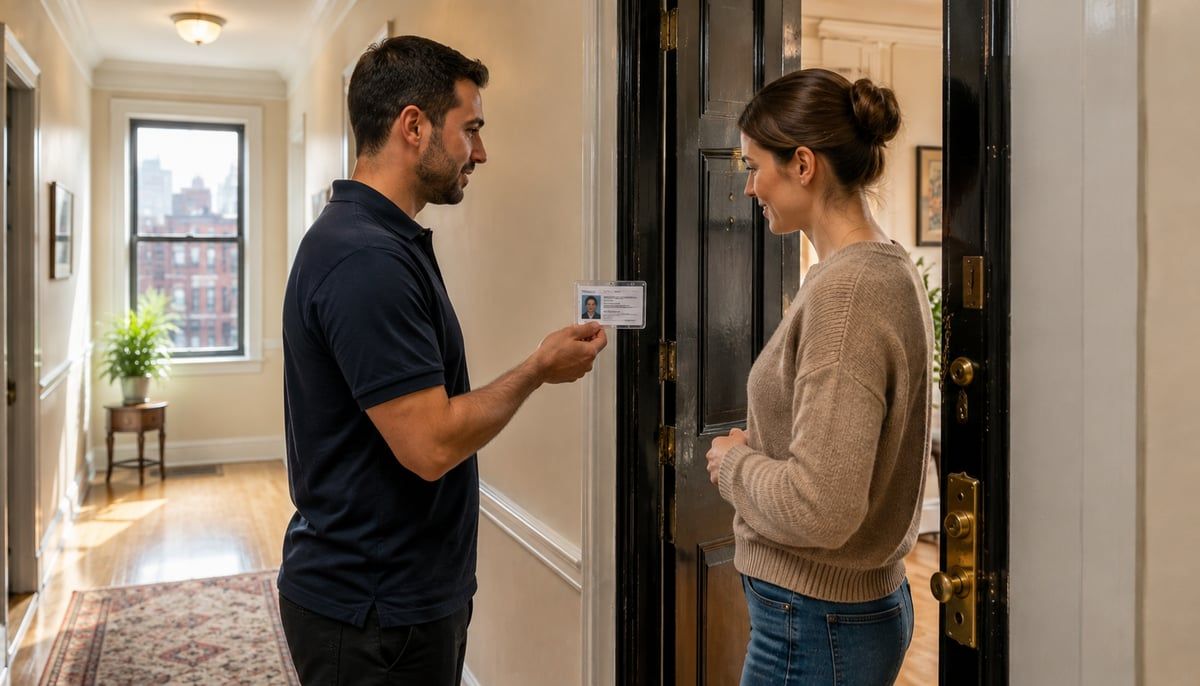
- Be prepared to show identification and proof that you live at, or are authorized to access, the property. NYC rules require the locksmith to make a good faith effort to obtain two forms of identification, one of them photo ID if you have it, along with evidence that you own the property or are authorized to have it opened. If you do not have photo ID on you, a witness who can vouch for you, a neighbor or building staff, is an accepted substitute.
- Confirm the price again, out loud, before any work starts. Hold firm on the number you were quoted if the price jumps with no clear reason.
- This is someone you are letting into your home, sometimes late at night. Trust your judgment and end the interaction if anything about it feels off.
What a legitimate NYC lockout actually looks like
If a locksmith asks for your ID or proof you live there, that is not a red flag, it is the job. NYC rules require the locksmith to document the opening on a two-part form: their license number, the location, the date and time, a description of the item and how it was opened, the evidence you provided of ownership or authorization, and your identification. You fill out part of the form yourself.
Acceptable evidence of ownership or authorization is broader than people expect: a lease, a deed, a utility bill addressed to you, or verification from a family member or your employer can all count, not just a government ID with your current address on it.
- A locksmith who skips this entirely, no ID request, no form, nothing, is doing the opposite of what NYC requires, not a sign of a faster or friendlier service.
- Having your ID and something with your name and current address ready before you call, a piece of mail, a lease, a utility bill, makes the whole process faster.
Rekey, replace, or go smart?
These three get confused constantly, and picking the wrong one usually means paying for more than you needed. Rekeying changes the internal pin configuration inside the existing lock cylinder so old keys stop working; the physical lock itself stays in place, which is why it usually costs meaningfully less than a full replacement.
- If you want keyless entry, a code you can share and revoke, or a log of who came and went, that is a smart lock rather than a standard rekey or replace. If you rent, it comes with a real legal step most people skip, not just a hardware decision, covered in the guide below.
| Situation | Usually makes sense |
|---|---|
| Lost a key, or just moved in | Rekey |
| Want old keys to stop working | Rekey |
| Lock is damaged or drilled | Replace |
| Lock is old or worn out | Replace |
| Want a higher security grade | Replace |
| Want keypad or app access | Smart lock |
If you rent, or live in a co-op or condo
Changing a lock is not always just an individual decision. If you are in a co-op, condo, rental building, or NYCHA property, check the building's rules before replacing the lock. Some buildings use master-key systems, restricted keyways, or building-wide access systems, and a co-op or condo's alteration-agreement rules can apply to entry-door hardware separately from your lease.
Before you pay
NYC requires a business to give you a receipt automatically for any purchase over $20, and on request for purchases between $5 and $20. Ask for one before the locksmith leaves.
- The receipt should show the business name and address, the DCWP license number if the business is licensed, the amount paid for each item, the total including tax, and the date. Keep it. If you ever need to file a DCWP complaint, you will need documentation like this.
- Test the lock and every new key or code yourself before the locksmith leaves, so you are not stuck again five minutes later.
- Prefer a payment method that gives you a clear transaction record and, where applicable, dispute protections if something goes wrong.
If something goes wrong
- If the price changes after the locksmith arrives, stop before authorizing any additional work. Ask exactly what changed and why, and decide whether to proceed before they start it.
- If the door or frame gets damaged, photograph it immediately and keep the invoice and payment record.
- NYC residents can file a locksmith complaint with DCWP through a dedicated NYC311 process, whether or not the business is located in the city.
Find licensed locksmiths by borough
Availability, response time, and pricing differ across the city. Use the borough listings below to compare licensed locksmiths where you actually need one, or browse the full list of licensed NYC locksmiths ServHom has verified.
How to use this before you hire
Use the checks in this guide no matter who you end up hiring. When you are ready to compare providers directly, ServHom shows source-labeled business facts and money-blind ranking for NYC pros, so you can see why a business is listed, not just that it is.
FAQ
Do locksmiths need a license in NYC?
Yes, as of August 2026. NYC requires locksmiths to hold an individual Locksmith License issued by DCWP. That is scheduled to change: starting May 31, 2027, per Local Law 183 of 2025, DCWP moves to a business-level Locksmith Business license instead. Through May 30, 2027, ask for the individual license number and confirm it before work starts.
How do I check a NYC locksmith's license?
Use DCWP's public Check License tool, free and with no account required. On a ServHom profile we also show license details up front so you can confirm you are dealing with a real, licensed business before you call.
How much does a locksmith cost in NYC?
Angi's July 2026 New York-specific data puts the average residential visit at about $213, with most jobs falling between $130 and $298. The exact price depends on the job, time of day, and hardware. See the full cost guide for a job-by-job breakdown.
Is it cheaper to rekey or replace a lock?
Rekeying is usually cheaper because it reuses your existing lock hardware and just changes the internal pin configuration, rather than replacing the physical lock. If your hardware is in good condition, ask whether rekeying solves the problem before paying for a full replacement.
Can a locksmith drill my lock?
Sometimes, yes, and it is occasionally genuinely necessary depending on the lock and situation. The red flag is not drilling itself, it is a technician recommending it immediately without explaining why non-destructive options will not work. Ask what they tried first, or plan to try, before agreeing to drilling.
What should I do if the locksmith changes the price?
Stop before authorizing any additional work. Ask exactly what changed and why, and only agree once you understand and accept the new scope and price. Keep the quote and the receipt, and you can file a locksmith complaint with DCWP through NYC311 if needed.
Can a renter change their locks in NYC?
Often, yes, but do not treat it as purely a hardware decision. NYC's HPD states that a tenant who changes their own lock is required to give the landlord a copy of the key; for a keyless smart lock, confirm with your landlord or building manager how access should be provided instead. Check your lease and building rules before you buy a new lock. See the smart lock installation guide for the full breakdown.
Related guides
8 min read
How Much Does a Locksmith Cost in NYC?
A locked door at 11pm and a locked door on a Tuesday afternoon are not the same price. Here is what a locksmith actually costs in NYC by job and by hour, and how to tell a fair quote from a scam before anyone shows up.
8 min read
How Much Does Smart Lock Installation Cost in NYC?
A keypad deadbolt promises you never lose a key again, but if you rent, swapping your own lock isn't just a locksmith question, it's a legal one. Here is what installation actually costs, and the one step most tenants skip.