NYC price guide
How Much Does Drywall Repair Cost in NYC?
A shelf comes off the wall, a leak leaves a stain, or a mover clips the hallway on the way out. Before you even call someone, here is what drywall repair and installation actually cost in NYC, and a federal rule tucked into most patch jobs that almost nobody checks for.
Quick Takeaways
- Small drywall repairs (holes, dents, minor cracks) commonly run $20 to $400; ceiling repairs and water damage run $220 to $1,550+, based on national cost-data aggregators reviewed August 2026 (ServHom does not yet have its own drywall-insulation fair-price benchmark).
- A full room of new drywall installation runs $300 for a small bathroom up to $3,900+ for a garage, and $5,500 to $45,000+ for a whole house, according to HomeGuide's own room-by-room data.
- Handypeople typically charge about $60 an hour for small patch jobs; contractors run closer to $90 an hour and are the better call for extensive damage or full-wall replacement.
- Finish level is a real, separate cost driver: a wall taped and mudded with no texture costs far less per square foot than one finished smooth for satin or glossy paint, the finish most rooms actually get.
- Most NYC drywall patch and plaster work does not need a Department of Buildings permit (DOB lists "plastering" as an example of exempt work), but the contractor still needs a DCWP Home Improvement Contractor license for any paid job.
- A federal rule most homeowners have never heard of can decide who is legally allowed to do the work: in a pre-1978 building, patches disturbing 6 square feet or less of painted surface per room are generally exempt from the EPA's lead-safe certification rule, but bigger patches and full-wall replacements are not.
- On ServHom no drywall pro can pay to rank higher, and we surface trust signals where we have them.
The real decision: is this a $50 patch or a bigger problem
A shelf comes off the wall and takes a chunk of drywall with it. A slow leak leaves a soft, stained patch above the shower. A mover clips the hallway wall on the way out with the couch. In the moment, the question is never "what is a fair price," it is "can I patch this myself, or is this actually a bigger job than it looks."
NYC complicates that question further. A lot of the housing stock predates 1978, some of it predates 1960, and the size of the patch, not just the damage itself, can determine whether special rules apply before anyone touches the wall. Getting that part wrong is a different kind of expensive than overpaying for a patch.
| Situation | What usually makes sense |
|---|---|
| Nail hole or small dent | Patch |
| Doorknob-size hole | Patch |
| Single crack or seam | Patch |
| Isolated water stain, leak already fixed | Patch, once the wall has fully dried |
| Water damage that keeps recurring in the same spot | Replace the damaged section; recurring damage usually means an unresolved leak |
| Damage spread across a large section of one wall | Replace |
| A wall patched so many times a clean, even finish is no longer realistic | Replace |
What drywall repair and installation actually cost in NYC
These ranges come from national cost-data aggregators (reviewed August 2026) and HomeGuide's own published drywall installation data (reviewed August 2026, fact-checked). ServHom does not yet have enough submitted drywall-insulation price reports of its own to publish a fair-price benchmark for this service, so these are labeled external ranges, not ServHom data.
- Small holes and dents: $20 to $150, the most common patch job by far.
- Larger holes, cracks, and joint or seam repairs: $50 to $400, depending on length and whether texture matching is needed.
- Ceiling repairs: $220 to $1,300, since ceiling work usually needs scaffolding or ladder setup and is slower to finish overhead.
- Water damage: $600 to $1,550, the most expensive common repair, since it often means replacing compromised material, not just patching the surface.
- New drywall installation, whole room: roughly $300 to $1,000 for a small 5x8 bathroom, $580 to $1,800 for a 12x12 bedroom, up to $1,000 to $3,900 for a 20x20 garage.
- New drywall installation, whole house: $5,500 to $22,000 for 1,500 square feet, scaling up to $45,000+ for larger homes.
- Hourly rates: about $60 an hour for a handyperson on small jobs, closer to $90 an hour for a contractor handling larger repairs or full walls.
- As with most home-service categories, NYC's own rates tend to sit toward the higher end of these national ranges, particularly in Manhattan and in buildings with difficult access, like walk-ups or a tight service elevator.
Estimate your drywall cost
A ballpark range based on national cost-data aggregators (repair) and HomeGuide's 2026 room-by-room installation data, the same figures cited in this guide. It is a starting point, not a quote, so always get a couple of written estimates for your actual job.
Cost by damage type
Bars show the low-to-high range for each damage type.
What actually drives the price
Two jobs that sound similar on the phone can end up priced very differently. These are the real factors.
- Finish level: a wall hung with no tape or mud (level 0) costs far less per square foot than one finished smooth for satin or glossy paint (level 5), the finish most rooms actually receive.
- Texture matching: if your existing wall has texture, matching it after a patch adds real cost, roughly $1 per square foot, on top of the base repair.
- Accessibility: damage on a tall wall, a ceiling, or behind fixtures takes longer and often costs more, since it needs ladders or extra setup.
- Debris removal and painting: larger repairs typically add a separate debris charge (commonly around $200) and a paint job to match, neither included in the base repair price.
- Material: true drywall work is priced differently from repairing old plaster, common in NYC's prewar buildings, a different, often pricier, skill set.
- Hidden damage: repair estimates assume a clean patch. If the drywall damage exposes wiring or a plumbing issue behind the wall, that adds a separate specialist's cost on top.
Cost per square foot, by finish level
Finish level is one of the biggest real drivers of installation cost. Most residential drywall receives a level 4 or 5 finish, smooth enough for flat, satin, or gloss paint.
How drywall repair actually works
A patch itself is not the slow part. What takes time is drying.
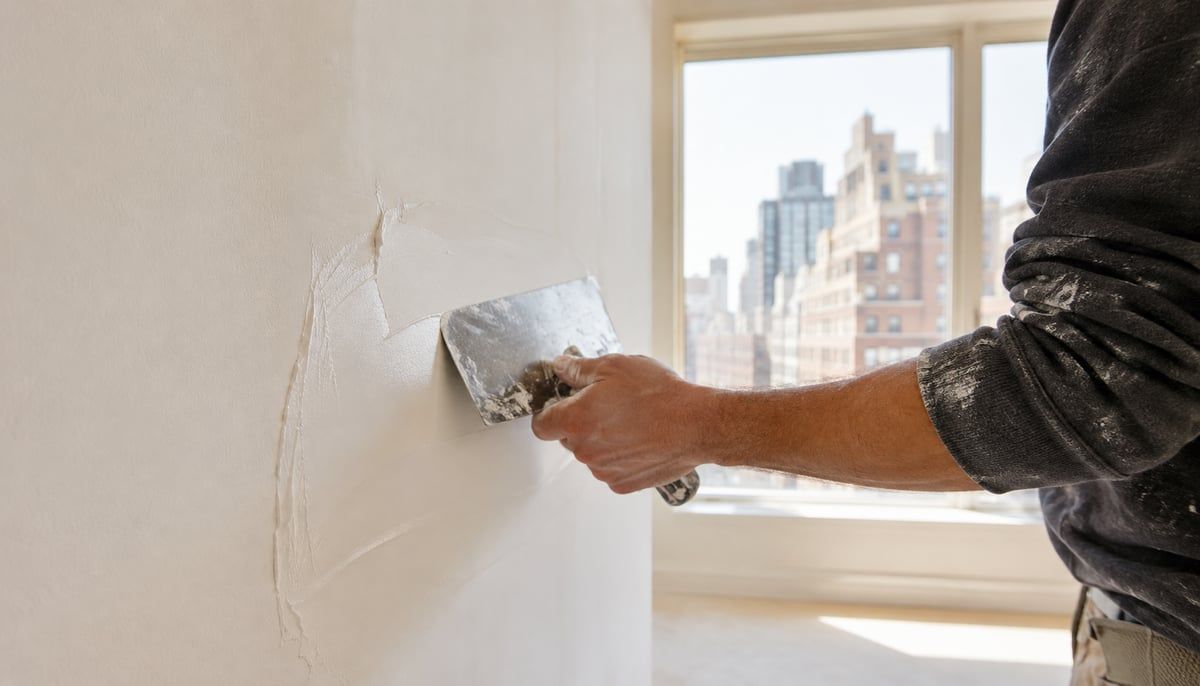
Each coat of joint compound commonly needs about a day to dry before the next coat, sanding, priming, or painting can happen. That drying time, not the hands-on labor, is why a patch that takes well under an hour to apply can still leave a room off-limits for a day or two before it is paint-ready, and why a full room of new drywall commonly takes 2 to 3 days start to finish. Here is the actual sequence:
- 1Remove loose or damaged material and clean out the area.
- 2Add backing, a scrap of wood or a repair clip, behind larger holes so the patch has something to hold onto.
- 3Cut and set a drywall patch for larger damage, or apply spackle or joint compound directly for small holes and dents.
- 4Tape the seams.
- 5Apply joint compound in thin coats, sanding lightly between coats.
- 6Prime the patched area so it absorbs paint evenly.
- 7Paint to match, either just the patch or, more often, the full wall for an even finish.
The lead-paint rule most small patches never trigger, and the ones that do
Most small drywall patches in NYC never touch a single regulation. But a federal rule most homeowners have never heard of can change who is legally allowed to do the work, and it hinges on the age of your building and the size of the patch, not on whether you hired a professional or grabbed a $10 kit yourself.
Under the EPA's Lead Renovation, Repair and Painting (RRP) Rule, anyone paid to perform work that disturbs painted surfaces in a home built before 1978 generally must be certified in lead-safe work practices. The rule carves out a real exception: EPA defines "minor repair and maintenance" as work that disturbs 6 square feet or less of painted surface per interior room (20 square feet or less outdoors), as long as the job does not involve window replacement or demolishing a painted surface. Most single small-hole patches fall well inside that line and are exempt. A patch that spans a larger section of wall, or a full wall or room replacement, does not, and the contractor doing that work is legally required to be an EPA Lead-Safe Certified renovator if the building predates 1978.
New York City layers its own, separate rule on top, and it goes further than disclosure. Under HPD's Local Law 1, owners of most buildings built before 1960 must presume painted surfaces contain lead and address any lead-paint hazard, like peeling or damaged paint. If a child under 6 lives in the unit, the law requires an annual inspection, and any repair of an identified lead-paint hazard must be performed by certified workers using safe work practices, a real, separate NYC-specific certified-worker requirement, not just a notice. The federal rule and Local Law 1 use different cutoff years, 1978 versus 1960, and are triggered differently, so a given building and unit can fall under one, both, or neither depending on its age and who lives there.
Separately, the NYC Department of Buildings does not require a permit for plastering or other minor alterations and ordinary repairs, which covers most drywall patch work. A DCWP Home Improvement Contractor license is still required for anyone you pay to do it, permit or not.
For a routine patch job, none of this usually changes anything. It matters most for larger patches, ceiling work, or full-room installations in older NYC housing, exactly the kind of job where it is worth asking your contractor directly whether the work is expected to disturb more than 6 square feet of painted surface, and if so, whether they hold EPA Lead-Safe Certified renovator status.
How to vet a drywall pro before you hire
This is a category where almost anyone with a bucket of joint compound can call themselves a pro, and a bad hire means redoing the work, or worse, a botched patch on a lead-painted wall.
- Confirm the contractor holds an active NYC Home Improvement Contractor (HIC) license through DCWP, required for any paid home-improvement job in NYC regardless of whether a permit is needed.
- If your building was built before 1978 and the job is anything beyond a small single patch, ask directly whether the contractor holds EPA Lead-Safe Certified renovator status.
- Get the scope in writing: damage type and size, finish level, whether texture matching and paint are included, and the total, not just a per-hour rate.
- For water damage repairs, confirm the underlying cause, a leak or a plumbing issue, has actually been fixed first. If the source of the moisture is not resolved, even the best drywall repair will eventually fail again, and patching over an active leak is a repeat expense waiting to happen.
- Many lead-generation sites treat "verified" as little more than a paid listing fee, not an actual license check. ServHom's license verification is pulled from a public record, not a badge a business paid to display.
Finding a drywall pro you can trust
Once you know what a fair price actually looks like, whether you are dealing with a five-minute patch or a full room, the next challenge is finding someone who will do the job right the first time. Most ways to find one either sell your contact information to a list of companies who all call at once, or rank whoever paid the most for placement.
ServHom does neither. No drywall pro can pay to rank higher on ServHom, ever, and we surface the trust signals we have on file so you can compare pros on something other than who called first.
How to use this before you hire
Use the checks in this guide no matter who you end up hiring. When you are ready to compare providers directly, ServHom shows source-labeled business facts and money-blind ranking for NYC pros, so you can see why a business is listed, not just that it is.
FAQ
How much should I pay for drywall repair?
It depends heavily on the type of damage. Small holes and dents commonly run $20 to $150, larger cracks and joint repairs $50 to $400, and water damage $600 to $1,550, based on national cost-data aggregators reviewed August 2026. Get a couple of written estimates for your specific damage rather than relying on a single ballpark number.
Is it cheaper to repair or replace drywall?
For a single hole, crack, or dent, repairing is almost always cheaper than replacing the whole section, often by a wide margin. Full replacement becomes the more sensible option when damage is extensive, keeps recurring in the same spot (often a sign of an underlying leak), or a wall has been patched so many times that a clean, even finish is no longer realistic.
How much would it cost to drywall a 1,500 sq ft house?
Based on HomeGuide's published room-by-room and whole-house data, a 1,500 square foot home commonly runs $5,500 to $22,000 for new drywall installation, including hanging, taping, and finishing. The actual number depends heavily on ceiling height, layout, and the finish level chosen.
Can a handyman patch drywall?
Yes, for small jobs. Handypeople typically charge around $60 an hour and are a common, cost-effective choice for small holes and dents. For extensive damage, full-wall replacement, or a pre-1978 building where the patch is larger than about 6 square feet, a licensed contractor, and in some cases an EPA Lead-Safe Certified renovator, is the safer call.
How long does it take to fix a patch of drywall?
It depends mainly on drying time between coats of joint compound, the same reason a full room of new drywall commonly takes 2 to 3 days and a whole house takes 3 days to a week, according to HomeGuide's own installation timelines. A small patch needing only one or two coats can often be paint-ready within a day or two; larger or textured repairs take longer.
How soon can you paint after a drywall repair?
Only once the joint compound has fully dried and been primed, commonly a day or two after the final coat for a small patch. Painting over compound that is still damp is a common mistake that leads to visible flashing or a patch that shows through the paint later.
How do you match wall texture after a drywall repair?
By identifying the existing texture first, since techniques like knockdown, orange peel, or a smooth level 5 finish each require a different application method to blend in. This is one of the harder parts of a repair to do well, and it is a real reason texture matching adds cost on top of the base patch price, since a mismatched texture is often more noticeable than the original damage.