NYC price guide
How Much Does Spray Foam Insulation Cost in NYC?
A drafty room, a heating bill that keeps climbing, or an uninsulated attic before winter. Here is what spray foam insulation actually costs in NYC by type and job size, the NYSERDA Comfort Home incentives listed for qualifying packages, and the fire-code rule that decides how it has to be installed.
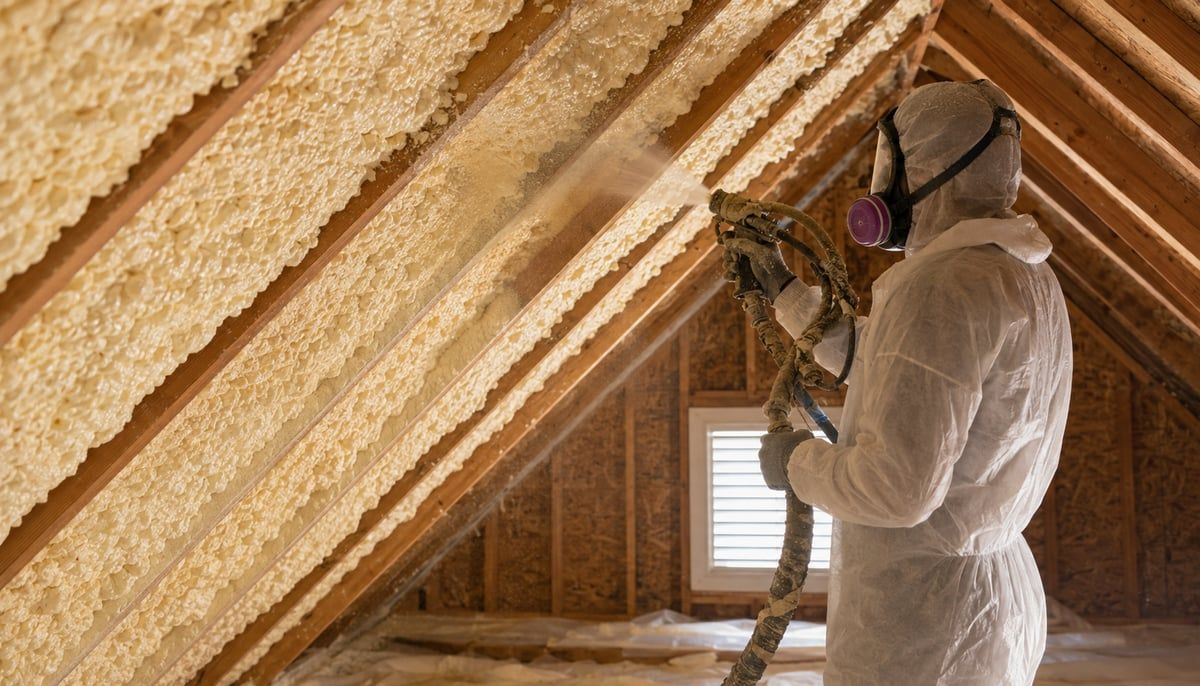
Quick Takeaways
- Spray foam insulation in NYC runs roughly $1.50 to $3.00 per sq ft for open-cell foam and $1.75 to $4.50 per sq ft for closed-cell, based on national cost-data aggregators cross-checked against real NYC-area contractor pricing, reviewed August 2026.
- Closed-cell foam costs more per square foot but has a higher R-value per inch, adds real rigidity, and acts as its own vapor barrier; open-cell is cheaper, expands more to fill gaps, and stays vapor-permeable, often the better call for interior walls.
- NYSERDA's Comfort Home Program lists incentives: $2,500 for a "Good" seal-and-insulate package, $3,000 for "Better" (adds walls and floors), plus $2,000 for a windows add-on, an incentive most homeowners never check for before getting quotes.
- NYC's Building Code requires spray foam exposed to a room's interior to be covered by an approved thermal barrier, typically 1/2-inch drywall. In an attic or crawl space entered only for utility access, a lighter ignition barrier is allowed instead, but bare exposed foam is a real code violation, not just a cosmetic choice.
- Insulation retrofits to existing construction generally fall under NYC's "minor alterations" permit exemption, but a contractor doing work totaling more than $200 generally still needs an active DCWP Home Improvement Contractor license regardless.
- On ServHom no insulation pro can pay to rank higher, and we surface the trust signals we have on file.
What spray foam insulation actually costs in NYC
Open-cell foam runs $1.50 to $3.00 per square foot; closed-cell runs $1.75 to $4.50 per square foot. These are national per-square-foot figures, cross-checked against real NYC and NY-area contractor pricing: a real NYC-specific average project runs $1,463 to $2,926 (average around $2,128), and local per-board-foot pricing from NY/NJ/Long Island contractors falls in the same range once converted to a comparable basis.
Use the calculator above for your specific foam type and job size, or the chart below as a quick reference.
Estimate your spray foam insulation cost
A ballpark range based on national cost-data aggregators, cross-checked against real NYC-area contractor pricing. It is a starting point, not a quote, so always get a few written estimates.
Price range by job size, open-cell
Bars show the low-to-high range for each job size, at the foam type selected above.
Open-cell vs. closed-cell: which one do you need
This is the single biggest cost and performance decision in the whole job, and a lot of quotes do not clearly explain why one costs more than the other.
- Closed-cell has a higher R-value per inch than open-cell, so it insulates more per inch of thickness, useful where cavity depth is limited.
- Closed-cell adds real structural rigidity to the area it is applied to and acts as its own vapor barrier, which is why it is common on exterior walls, roof decks, and rim joists, spaces where moisture control matters most.
- Open-cell expands more to fill irregular gaps and stays vapor-permeable, letting a wall assembly "breathe." That is often the safer, and cheaper, choice for interior walls, where trapping moisture inside a closed system is a real risk if the assembly is not designed for it.
- Neither one is universally correct. The right choice depends on where in the building it is going, not just which one costs less per square foot.
What actually drives the price
Two insulation jobs that sound similar on the phone can land on very different quotes. These are the real reasons why.
- Foam type: closed-cell costs more per square foot than open-cell, for the reasons above.
- Accessibility: an open attic is the easiest, cheapest access point. Injecting foam into an already-finished wall cavity, drilling and patching each bay, costs more than spraying an open space.
- Removal first: if old, damaged, or compressed insulation needs to come out before new foam goes in, that is a separate line item on top of the install.
- Thickness and R-value target: more coverage, more material, higher cost, especially for closed-cell where even a modest thickness increase adds real material cost.
- Job minimums: most insulation contractors have a minimum service charge, so a very small job can cost more per square foot than a mid-size one.
The NYSERDA incentive most homeowners miss
This is a real NYSERDA incentive that most people never check for before getting quotes. Through NYSERDA's Comfort Home Program, a qualifying "seal and insulate" package is listed with an incentive: $2,500 for the "Good" package (sealing plus attic and rim joist insulation), $3,000 for "Better" (adds wall and floor insulation), and an additional $2,000 available as a windows add-on once air-sealing and insulation are done.
NYSERDA's page says these packages are offered by trained and qualified Comfort Home contractors and that incentives "may be available," so eligibility and current amounts are NYSERDA's to confirm. Before you get a quote, ask any insulation contractor you are considering whether they are a Comfort Home contractor and how any incentive shows up in your price, since that answer changes what the job costs you out of pocket.
The fire-code rule that decides how it can be installed
Spray foam is foam plastic insulation, and NYC's Building Code sets specific fire-protection requirements for it. Under Section BC 2603.4, foam plastic insulation exposed to the interior of a building generally must be separated by an approved thermal barrier, typically 1/2-inch drywall, that limits fire exposure for at least 15 minutes. Bare, exposed spray foam in a finished, occupied space is a real code violation, not just an aesthetic issue.
There is a real, common exception: in an attic or crawl space entered only for servicing utilities, the code allows a lighter ignition barrier instead of a full thermal barrier, specific materials like 1.5-inch mineral fiber insulation or 3/8-inch gypsum board, rather than requiring a full drywall covering in a space nobody actually occupies. This is exactly the scenario most homeowners are in when they search for attic spray foam pricing, and it is worth confirming your contractor is using one of the approved methods, not leaving foam fully exposed.
Do you need a permit, and who can do the work
Insulation retrofits to existing construction, like adding attic or wall insulation, generally fall under NYC's "minor alterations and ordinary repairs" permit exemption (Administrative Code 28-105.4.2), since the work does not touch load-bearing walls, fire-rated assemblies, required exits, or plumbing and fire-suppression systems. Always confirm with your contractor, since a job combined with other structural changes can change that answer.
Permit or not, a contractor you pay for insulation work totaling more than $200 generally still needs an active NYC Home Improvement Contractor (HIC) license through DCWP, since NYC311 lists renovations and repairs costing more than $200 among covered work. That requirement does not depend on whether the specific job needs a permit.
DIY or hire a pro
Small off-the-shelf spray foam kits exist and are a real option for sealing gaps, rim joists, or a small, accessible area. They are not a realistic substitute for insulating a full attic or a whole home's worth of wall cavities.
- A DIY kit can make sense for a single small area you can reach safely and cover completely yourself.
- Even coverage matters more with spray foam than with batts or blown-in material. A real, recurring complaint in homeowner discussions is uneven application, thin spots, or gaps left behind a finished wall where nobody can see them until there is a problem.
- Code compliance is a real reason to hire a pro for anything beyond a small patch: the thermal or ignition barrier requirement above applies regardless of who does the spraying, and a licensed contractor is the one accountable if it is done wrong.
- If you are unsure whether your situation is small enough for DIY, an accessible attic with simple geometry usually is; a finished wall cavity, a roof deck, or anything requiring removal of old material first usually is not.
How to vet an insulation pro before you hire
- Confirm the contractor holds an active NYC Home Improvement Contractor (HIC) license through DCWP, which is required for home improvement work totaling more than $200 whether or not a permit is needed. In a building with more than four units, DCWP says a license is required for work contracted by an owner or tenant in the apartment where that person lives.
- Ask directly whether they are a NYSERDA Comfort Home contractor, and get the real out-of-pocket price after any incentive, not just the sticker price.
- Ask which cell type they recommend for your specific space and why, not just which one they happen to stock.
- Confirm how the job will be covered for fire-code compliance: full drywall thermal barrier in a finished space, or an approved ignition barrier in an attic or crawl space.
- Get the scope in writing: area covered, foam type, target thickness or R-value, and the total, not just a per-square-foot rate.
Finding an insulation pro you can trust
Once you know the real price range, the incentive to ask about, and the code requirement that decides how the job should be covered, the next challenge is finding someone who will actually get it right. Most ways to find one either sell your contact information to a list of companies who all call at once, or rank whoever paid the most for placement.
ServHom does neither. No insulation pro can pay to rank higher on ServHom, ever, and we surface the trust signals we have on file so you can compare pros on something other than who called first.
How to use this before you hire
Use the checks in this guide no matter who you end up hiring. When you are ready to compare providers directly, ServHom shows source-labeled business facts and money-blind ranking for NYC pros, so you can see why a business is listed, not just that it is.
FAQ
How much does it cost to spray foam 1,000 square feet?
Roughly $1,500 to $3,000 for open-cell foam, or $1,750 to $4,500 for closed-cell, based on national per-square-foot cost data cross-checked against real NYC-area pricing. The exact number depends on accessibility, thickness needed, and whether old insulation has to come out first.
How much does it cost to spray foam a 1,500 sq ft home?
Roughly $2,250 to $4,500 for open-cell foam, or $2,625 to $6,750 for closed-cell, treating the full square footage as the area covered. Most whole-home jobs mix zones (attic, walls, rim joists), so get an itemized quote by area rather than one flat number.
Is it cheaper to spray foam or install regular insulation?
Yes, spray foam costs more upfront per square foot than fiberglass batts or blown-in cellulose. The tradeoff is a better air seal and, for closed-cell, a higher R-value per inch, which can lower energy bills over time. Whether that upfront premium is worth it depends on your specific space and how long you plan to stay in it.
How much does it cost to spray foam 200 square feet?
Roughly $300 to $600 for open-cell foam, or $350 to $900 for closed-cell, though very small jobs often run higher per square foot once a contractor's minimum service charge is factored in.
Is there a rebate for insulation in NYC?
NYSERDA's Comfort Home Program lists incentives of $2,500 for a Good seal-and-insulate package and $3,000 for Better, plus $2,000 for a windows add-on, through Comfort Home contractors. The program page says incentives "may be available," so confirm eligibility with NYSERDA and ask any insulation contractor whether they are a Comfort Home contractor before you get a quote.
Do I need a permit for insulation work in NYC?
Usually no. Insulation retrofits to existing construction generally fall under NYC's "minor alterations and ordinary repairs" permit exemption, since the work does not touch load-bearing walls, fire-rated assemblies, exits, or plumbing systems. A contractor doing work totaling more than $200 generally still needs an active DCWP Home Improvement Contractor license regardless of the permit question.