NYC homeowner guide
Masonry Repair and Restoration in NYC
NYC masonry repair can run anywhere from a $600 repointing touch-up to $100,000 or more for a full brownstone facade restoration, and the difference is almost entirely about scope, not the size of the building. This guide covers two common NYC masonry projects, routine repair (repointing, chimney work, sill replacement) and full brownstone facade restoration: what each actually costs, when NYC building and landmarks rules apply, and how to hire someone you can trust.
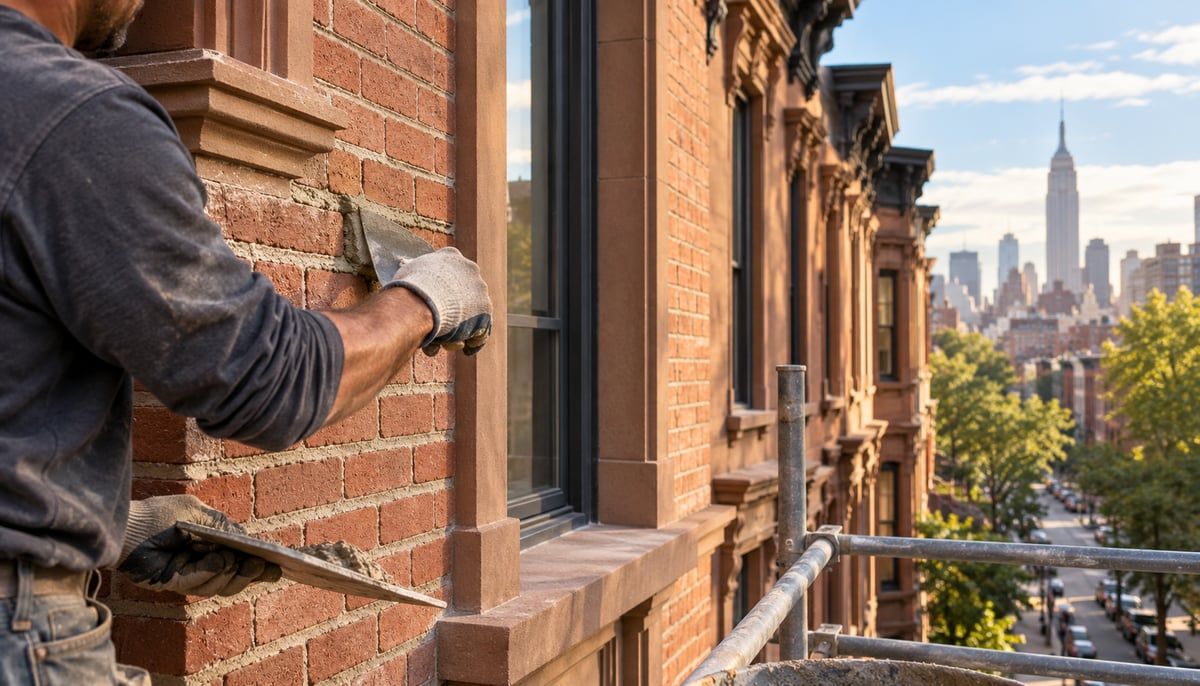
Quick Takeaways
- This guide covers two common NYC masonry projects: routine repair (repointing, brick replacement, chimney and sill work) and full brownstone facade restoration. See the full guides below for the job-by-job cost breakdown behind each.
- Routine repointing commonly runs $8 to $35 per square foot, individual brick replacement $50 to $120 per brick, and chimney repair $900 to $3,000+. A full brownstone facade restoration is a much bigger project: $10,000 to $30,000 for minor repairs and repointing, $70,000 to $100,000 for a standard overhaul, and $100,000+ for a larger or more deteriorated facade. Treat these as planning ranges, not quote guarantees; access, condition, and historic-material requirements move the real number a lot.
- NYC has no separate license for masons the way it does for plumbers or electricians. For a building with four residential units or fewer, masonry work over $200 generally needs a Home Improvement Contractor (HIC) license from DCWP. A larger building falls under a different DOB contractor-registration and permit framework instead, so ask which one actually applies rather than assuming HIC covers it.
- If your building is in a historic district or individually landmarked, LPC generally issues a permit for masonry repair, repointing, and brownstone resurfacing rather than treating it as exempt "ordinary maintenance." LPC also explicitly prefers repairing only the deteriorated areas of a brownstone facade over resurfacing the entire thing, which it permits only when the historic material is in extremely poor condition.
- Buildings over six stories face mandatory facade inspections every 5 years under Local Law 11 (FISP). An "Unsafe" finding must be corrected within 90 days (subject to extensions); a "SWARMP" finding gets a longer, inspector-assigned deadline of one to five years, not an open-ended one.
What counts as masonry work, and which guide you need
NYC masonry repair can run anywhere from a $600 repointing touch-up to $100,000 or more for a full brownstone facade restoration, and the cost expectations and rules that apply depend heavily on which one you are actually facing. This guide covers brick and brownstone residential masonry specifically, the two most common starting points homeowners search for. Limestone, granite, terra cotta, poured-concrete facade systems, and larger apartment-building facade work can follow different pricing and regulatory paths not covered here.
If you are looking at a cracked stoop, a leaning chimney, a few loose bricks, or general repointing, the routine repair guide below has the full job-by-job cost breakdown. If you own a brownstone, or another landmarked or historic-district building, and are looking at a fuller facade restoration, the second guide covers the real cost range and the specific landmarks question that explains why two quotes for what sounds like the same job can be five times apart.
What masonry work costs in NYC
These ranges come from published NYC masonry restoration pricing and real NYC-specific project data. ServHom does not yet have enough submitted masonry price reports of its own to publish a fair-price benchmark for this service, so these are external planning ranges, not ServHom data and not a quote guarantee. Access, building height, facade condition, and historic-material requirements can all move a real quote well outside these numbers. See each full guide below for the complete job-by-job breakdown and sourcing.
| Project | Typical cost range |
|---|---|
| Brick repointing (tuckpointing) | $8 to $35 per sq ft |
| Individual brick replacement | $50 to $120 per brick |
| Surface spalling patching | $20 to $40 per sq ft |
| Chimney masonry repair | $900 to $3,000+ |
| Crack repair (mortar injection) | $300 to $800 per crack |
| Masonry sill replacement | $300 to $800 per sill |
| Brownstone facade, minor repairs | $10,000 to $30,000 |
| Brownstone facade, standard overhaul | $70,000 to $100,000 |
| Brownstone facade, larger or more deteriorated | $100,000+ |
Before you compare two quotes, compare the scope
Two masonry quotes for what sounds like the same job can land tens of thousands of dollars apart without either contractor being dishonest. Using the ranges above: a "brownstone facade" quote could mean $10,000 to $30,000 of selective patching and repointing on a few deteriorated areas, $70,000 to $100,000 or more for a standard full-facade overhaul, or well over $100,000 for a larger or more deteriorated facade needing extensive stone replacement. Those are three different jobs wearing the same name.
Before deciding a quote is too high or too low, ask exactly what it covers: which specific areas or elevations, whether it is selective repair or full resurfacing, what access equipment (scaffolding, a sidewalk shed, a lift) is included, and whether permit filing or an LPC application is part of the price or billed separately. A much cheaper quote that quietly skips scaffolding, a permit filing, or LPC-required documentation is not actually a lower price for the same job.
What should be in a masonry quote
A number on a page is hard to compare against anything without a written scope behind it. NYC's own consumer-protection rules for licensed home improvement work back this up: DCWP requires an HIC-licensed contractor to give you written notice, before you sign anything, of every permit the job needs, which party is obtaining each one, the steps involved, the estimated fees, and how you can verify the permit's status.
- The specific facade, elevation, or area being repaired, with approximate square footage.
- Whether the job is selective repair or full resurfacing, and why.
- Materials: brick or stone type, mortar specification, and whether a mortar analysis is included for a landmarked building.
- Access equipment included, such as scaffolding, a sidewalk shed, or a lift, and who pays for it.
- Who is filing for a DOB permit or an LPC application and who pays those fees, in writing, not just "permits included."
- Cleaning method proposed, and confirmation that it is not sandblasting if the building is landmarked.
- Warranty terms backed by the company, not just a verbal "personal guarantee."
- Payment schedule and change-order process.
Do you need a permit, or landmarks approval
NYC has no separate trade license for masons. For a building with four residential units or fewer, masonry work valued at $200 or more generally needs a Home Improvement Contractor (HIC) license from DCWP, since NYC Admin Code Section 20-386 defines the "building" this specific law covers that way. Most brownstone and rowhouse masonry work happens on exactly that kind of building. A larger building instead falls under a different NYC Department of Buildings contractor-registration and permit framework, since which registration applies depends on the type of work, so ask the contractor directly which license or registration covers your building and this scope of work rather than assuming the HIC threshold applies everywhere.
Separately from that license question, small repointing and minor brick replacement usually do not need a NYC Department of Buildings permit at all. The specific rule is 1 RCNY 101-14, Table 3, which lists brick repointing, crack repair by mortar injection, and masonry sill replacement as no-permit work within real area limits, including individual brick replacement up to 10 square feet per instance and not exceeding 150 square feet cumulative across all facades. Larger repairs, or anything that touches the wall's structural backup, usually do need a permit.
If your building sits in a historic district or is individually landmarked, there is a third, separate approval layer, and it applies more often than that DOB permit rule might suggest: NYC Landmarks Preservation Commission (LPC) staff can issue a permit specifically for repointing masonry facades, repairing brick and historic cast stone, and repairing or resurfacing brownstone, meaning this work is generally treated as permit-required LPC work, not exempt "ordinary maintenance." LPC requires any repair, restoration, or replacement of historic material to match the original's design, detail, profile, dimension, material, texture, tooling, dressing, color, and finish, and explicitly prohibits sandblast cleaning on historic masonry, since it can cause permanent damage and let water infiltrate the building. If an individual landmark's facade needs to be completely repointed, LPC requires a mortar analysis first to determine the appropriate replacement mortar.
One easy-to-miss detail worth checking a contractor on: LPC specifically requires replacement mortar to be less strong and more permeable than the historic brick or stone it repairs, not harder. Mortar that is stronger than the surrounding masonry causes the masonry itself to crack and deteriorate over time, the opposite of what a repair is supposed to do. A soft, lime-rich mortar (roughly equivalent to ASTM Type O or N) is typically appropriate for older masonry; do not assume a contractor pitching a harder, higher-strength mortar as "more durable" is doing your building a favor.
When a masonry problem becomes a mandated repair, not an optional one
If you own a building over six stories, facade inspections are not optional. Under Local Law 11, also known as the Facade Inspection Safety Program (FISP), a qualified professional has to inspect the facade every five years, and the finding gets classified as Safe, SWARMP, or Unsafe, each with a real, different deadline attached. This is a common reason masonry work suddenly becomes urgent, and priced accordingly, rather than something you can shop around for slowly.
| FISP finding | What it actually requires |
|---|---|
| Safe | No repair required during the current inspection cycle. |
| SWARMP | Safe for now, but the inspector sets a specific repair deadline, one to five years out, that the owner still has to meet. |
| Unsafe | DOB currently requires the condition to be corrected within 90 days of the report filing, subject to an extension request. |
Routine repair or bigger restoration? A quick way to tell
Not every masonry problem is a routine repair. Anything in the right-hand column below is a real structural red flag, not a cosmetic one, worth a structural evaluation before you get cosmetic repair quotes at all.
| Signs pointing toward routine repair | Signs pointing toward bigger restoration |
|---|---|
| An isolated crack, a few loose bricks, or a damaged stoop element | Widespread delamination or spalling across the facade |
| Efflorescence (white powdery residue) limited to one area | Extensive water penetration throughout the wall |
| A single loose cornice, sill, or carved detail | Multiple prior repairs that already failed |
| No stair-step cracking or visible bowing | Stair-step cracks, a bulging or bowing wall, or a leaning chimney, all real structural red flags worth a structural evaluation before any cosmetic repair |
How to vet a mason
Masonry work carries real liability if something goes wrong, both for property damage and for injury, so checking credentials matters more than picking the lowest number on a page of quotes.
- Ask specifically which license or registration covers your building and this scope of work (an HIC license for a building with four units or fewer, a different DOB registration for a larger one), then verify it yourself rather than taking a verbal yes.
- Get a written scope of work, not just a price: which areas are being repaired or replaced, the specific materials (brick type, mortar grade), the warranty terms, and whether the quote already accounts for a DOB permit or LPC approval if one is needed.
- For HIC-licensed work, DCWP requires the contractor to give you written notice, before you sign anything, of every permit the job needs, who is obtaining each one, and how you can verify its status. Do not accept "permits included" as the whole answer.
- For work covered by NYC's HIC license, DCWP also caps the upfront deposit at no more than 25 percent of the total contract amount. A contractor asking for more before any work begins is a real red flag worth questioning.
- For a landmarked or historic-district building specifically, ask for examples of prior LPC-approved work and whether they have filed through LPC's Portico system before. Craftsmanship that genuinely matches historic material, and mortar that is appropriately soft rather than pitched as "extra strong," is a real skill gap between contractors, not a box every mason checks.
- Read a handful of specific, recent reviews rather than trusting a star average alone. Many lead-generation sites treat "verified" as little more than a paid listing fee, not an actual license check.
Finding a mason you can trust
Once you know what a fair price looks like, whether you are facing a routine repair or a bigger restoration, and what permits or landmarks approval apply, the next challenge is finding a provider who meets that bar.
On many lead-generation marketplaces, the same request gets sent to several competing companies at once, and the "verified" badge you see is often just a paid listing fee, not a real license or landmarks-experience check. ServHom takes a different approach: no mason can pay to rank higher, ever. Browse listings by borough below, or use the search here for the full NYC pool.
How to use this before you hire
Use the checks in this guide no matter who you end up hiring. When you are ready to compare providers directly, ServHom shows source-labeled business facts and money-blind ranking for NYC pros, so you can see why a business is listed, not just that it is.
FAQ
How much does masonry repair cost in NYC?
It depends heavily on the specific job. Routine repointing commonly runs $8 to $35 per square foot, individual brick replacement $50 to $120 per brick, and chimney masonry repair $900 to $3,000 or more. A full brownstone facade restoration is a much bigger project, commonly $10,000 to $30,000 for minor repairs up to $70,000 to $100,000 or more for a standard overhaul. See each full guide for the complete breakdown.
How much does brownstone facade restoration cost?
Minor repairs and repointing of select deteriorated areas commonly run $10,000 to $30,000. A standard facade overhaul on a typical 3-to-4-story townhome runs $70,000 to $100,000, and larger or more deteriorated facades can exceed $100,000. The real driver is scope, whether the job is targeted repair or a full resurfacing, not just the building's size.
Does NYC require a license for masonry work?
NYC has no separate trade license for masons. For a building with four residential units or fewer, masonry work over $200 generally needs a Home Improvement Contractor (HIC) license from DCWP. A larger building falls under a different DOB contractor-registration and permit framework instead, since the registration required depends on the type of work, so ask the contractor directly which license or registration actually covers your building rather than assuming HIC applies everywhere.
Do I need Landmarks Preservation Commission approval for masonry repair?
Generally yes, if your building is in a historic district or individually landmarked, independent of whether the job also needs a separate DOB permit. LPC staff can issue a permit specifically for repointing, brick and stone repair, and brownstone resurfacing, so treat this as permit-required work rather than assuming it counts as exempt routine maintenance. For a full brownstone facade, LPC only permits resurfacing the entire thing when the historic material is determined to be in extremely poor condition; otherwise it prefers repairing just the deteriorated areas. Sandblast cleaning is explicitly prohibited. Confirm whether your specific building is under LPC jurisdiction using the Discover NYC Landmarks map before assuming either way.
What triggers a mandated facade repair in NYC?
For buildings over six stories, Local Law 11 (the Facade Inspection Safety Program, or FISP) requires a qualified professional to inspect the facade every five years, and the finding is classified Safe, SWARMP, or Unsafe. An Unsafe finding currently has to be corrected within 90 days of the report filing, subject to an extension request. A SWARMP finding is less urgent: the inspector sets a specific repair deadline, one to five years out, that the owner still has to meet, not an open-ended one.
Can a handyman do masonry work in NYC?
It depends on the job's value and the building. For a building with four residential units or fewer, masonry work valued at $200 or more generally needs a licensed Home Improvement Contractor, not an unlicensed handyman. Genuinely minor work under that dollar threshold is a different case, the same rule that applies to other trades covered elsewhere on ServHom. For a larger building, a different DOB contractor-registration framework applies instead of the HIC threshold.
Top masonry pros in NYC







Related guides
10 min read
How Much Does Masonry Repair Cost in NYC?
A quote comes in and the first thought is: am I being overcharged, or is this actually normal for NYC. Here is what masonry repair actually costs in NYC by job type, and what actually drives the price.
9 min read
How Much Does Brownstone Facade Restoration Cost in NYC?
One Brooklyn homeowner spent $26,000 keeping a brownstone facade looking sharp. Another got quoted well over $100,000 for what sounded like a similar job. The gap usually is not a scam, it is the difference between fixing what is actually deteriorated and resurfacing an entire facade that does not need it. Here is what restoration actually costs, and the real question to ask before you agree to either.