NYC price guide
How Much Does Roof Installation Cost in NYC?
One Brooklyn homeowner paid $43,000 for a new roof. Another paid closer to $10,000 for what sounds like a similar job. The gap is not always a scam, sometimes it is a real NYC rule that quietly adds solar panels or a green roof to certain replacements. Here is what installation actually costs, and how to tell if that rule applies to you.
Quick Takeaways
- A full roof installation in NYC commonly runs $8,000 to $15,000 based on NY-specific contractor pricing, though national estimates range far wider, $5,800 to $47,000, depending heavily on roof size, material, and whether it is flat or pitched.
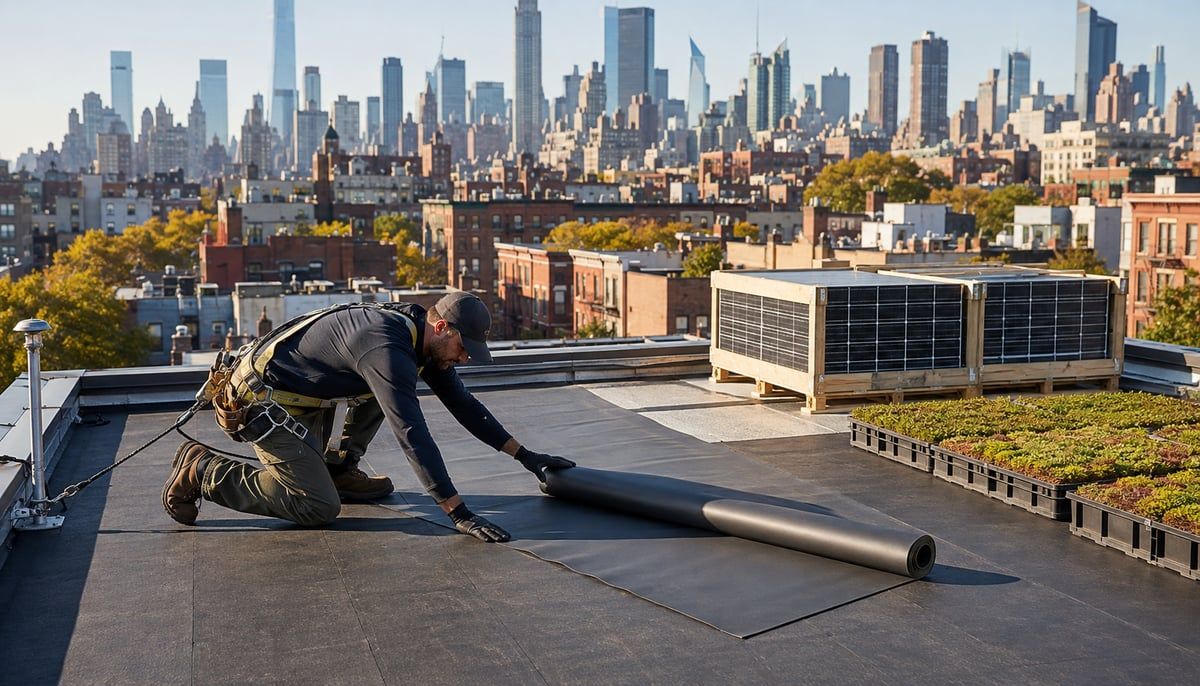
- NYC Local Laws 92 and 94 require certain roofs, when an existing roof deck or assembly is fully replaced, to be covered in a green roof, a solar energy system, or both. This does not apply to a simple repair, only to a full deck or assembly replacement.
- The solar/green roof rule mainly captures flat and low-slope roofs. A roof steeper than about 17 percent slope that could only fit a small solar system is generally exempt, which covers many typical pitched residential roofs.
- A New York State property tax abatement is available for a compliant green roof installation, a real financial offset most homeowners never hear about until after they have already priced the job.
- The often-cited "25 percent rule" for when a roof needs full replacement is a widely circulated industry guideline, not an NYC building code requirement. Treat it as a rule of thumb, not a legal threshold.
Why two roof quotes for the same size job can be $30,000 apart
A number like $43,000 for a roof replacement sounds like a red flag, until you find out a similar-sized job down the block ran a fraction of that. The instinct is to assume someone got scammed, or someone got a deal. Often the real answer is neither: NYC has a rule that can add a genuine solar or green roof requirement to certain full roof replacements, one most homeowners have never heard of until a contractor mentions it mid-quote.
What roof installation actually costs in NYC
Estimates vary more for a full roof installation than almost any other home service, because roof size, material, pitch, and number of layers to tear off all move the number substantially.
This Old House puts the average roof replacement cost in New York at $5,519, with a typical range of $4,254 to $13,879. A New York-based roofing company's own published pricing puts a typical installation at $8,000 to $15,000. National estimates from NerdWallet range far wider, $5,800 to over $47,000, reflecting everything from a small standard reroof to a large or complex job.
Real anecdotes from NYC homeowners show why the range is so wide: one Brooklyn flat-roof replacement (roughly 1,500 square feet) ran $43,000, while a smaller reroofing job elsewhere in the city ran closer to $10,000. Flat roofs, larger roofs, and roofs requiring full tear-off of multiple existing layers all push toward the higher end.
- NY-specific contractor pricing: $8,000 to $15,000 for a typical installation.
- This Old House NY average: $5,519, typical range $4,254 to $13,879.
- NerdWallet national range: $5,800 to over $47,000, reflecting the full spread of roof sizes and complexity.
Cost estimates by source
Three independently sourced estimates for a full roof installation, reviewed August 2026. The wide spread reflects real differences in roof size, material, and pitch, not disagreement about NYC pricing specifically.
The NYC rule most homeowners do not know about
This is the part a generic national cost guide will never mention, because it is specific to New York City building code.
- NYC Local Laws 92 and 94 require that, on new buildings and on existing buildings replacing an entire roof deck or roof assembly, 100 percent of the building's "Sustainable Roofing Zone" be covered by a green roof, a solar photovoltaic system, or a working combination of both. A simple repair does not trigger this. A full deck or assembly replacement does.
- The rule mainly affects flat and low-slope roofs. A roof section steeper than roughly 17 percent slope that could only fit a small solar system (under 4kW) is generally exempt, which covers a large share of typical NYC pitched residential roofs. Flat-roof buildings, common on rowhouse rear extensions and many apartment buildings, are the ones most likely to actually be affected.
- A New York State property tax abatement is available specifically for a compliant green roof installation, filed as part of the same DOB NOW submission. This can meaningfully offset the added cost, and it is easy to miss since it is not something most roofers bring up unprompted.
- Filings for solar or green roof compliance require a Registered Design Professional, and a solar installation specifically also requires a separate electrical filing by a licensed electrician. Ask early in the process whether your contractor is already set up to handle this, since it changes both cost and timeline.
| Roof condition | Likely subject to LL92/94? |
|---|---|
| Steep-slope section (over ~17% pitch) too small for 4kW of solar | Generally exempt |
| Flat or low-slope roof, full deck or assembly replacement | Likely yes |
| Area used for required rooftop access, mechanical equipment, or similar | Excluded from the calculation regardless of slope |
| A repair, not a full deck or assembly replacement | Not triggered either way |
What actually drives the price
Beyond whether the solar/green roof rule applies, several other factors explain most of the real spread in quotes.
- Flat versus pitched: a flat or low-slope roof generally costs more per square foot to install correctly than a standard pitched asphalt shingle roof, and is also the type most likely to trigger the Local Law 92/94 requirement above.
- Tear-off layers: removing one existing layer of roofing is a very different job from removing two or three stacked layers down to the deck, which adds real labor and disposal cost.
- Material: asphalt shingle sits at the lower end of the range, while metal, tile, or a compliant green roof system cost meaningfully more per square foot. Material also affects how long the investment lasts, worth weighing against the sticker price alone.
- Roof size and access: a larger roof footprint and a building with difficult access (no easy staging area, a taller building, a landmark district requiring extra care) both add cost beyond the raw square footage.
- Whether this is really a repair or a full installation: an isolated leak, a small area of storm damage, or a single flashing issue is usually a repair, not a full installation. If that describes your situation, our roof repair cost guide covers that narrower job and its own pricing.
| Material | Typical lifespan |
|---|---|
| Modified bitumen | 10 to 20 years |
| TPO | 15 to 25 years |
| Asphalt shingles | 20 to 30 years |
| EPDM | 20 to 30 years |
| Metal | 40 to 60 years |
How to vet a roofer for a full installation, not just a patch job
A full installation is a bigger, longer commitment than a repair, and it is worth a higher bar of scrutiny before signing anything.
- Ask whether the company is licensed as a Home Improvement Contractor with NYC's Department of Consumer and Worker Protection, bonded, and insured, and ask for proof, not just a verbal yes. This is required for home improvement work over $200 in NYC, which a full roof installation always exceeds.
- If your building has a flat or low-slope roof, ask directly whether Local Law 92/94 applies to your job and who is filing the DOB NOW paperwork if it does. A contractor who has not considered this either has not done many recent NYC roof replacements or is leaving you to find out later.
- Do not treat the "25 percent rule" you may read about online as an NYC legal requirement. It is a widely used industry guideline for the repair-versus-replace decision, not a building code threshold, and a contractor citing it as "the law" is stating it more strongly than it actually is.
- On any lead-generation marketplace, a "verified" badge is often just a paid listing fee, not a real license check. Money-blind ranking means no business can pay to appear higher in results, on ServHom or anywhere it operates that way, so what you see reflects real signals, not who paid the most.
Finding someone you can actually trust with this
Once you know the real cost range and the one NYC-specific rule most quotes will not explain upfront, the next challenge is finding a roofer who handles both the work and the paperwork correctly.
On many lead-generation marketplaces, the same request gets sent to several competing companies at once, and the homeowner has no real way to check who is actually licensed before the calls start coming in. ServHom takes a different approach: you see real, ranked roofing businesses with their information shown up front, and you review and choose who to contact yourself.
How to use this before you hire
Use the checks in this guide no matter who you end up hiring. When you are ready to compare providers directly, ServHom shows source-labeled business facts and money-blind ranking for NYC pros, so you can see why a business is listed, not just that it is.
FAQ
How much does it cost to put a shingle roof on a 2000 sq ft house?
National and NY-specific pricing suggests a job of that size commonly falls in the $8,000 to $20,000 range for standard asphalt shingle, depending on roof pitch, number of tear-off layers, and access. Get a written, itemized quote rather than relying on a single per-square-foot number, since those two factors move the total significantly.
What is the 25% rule for roofing?
The 25 percent rule is a widely circulated industry guideline suggesting that if more than about a quarter of a roof needs repair, full replacement may be more cost-effective than a patch job. It is not an NYC building code requirement or a legal threshold, so treat a contractor who cites it as if it were binding law with some skepticism.
Is $30,000 too much for a roof?
It depends entirely on the roof. For a large or flat roof, especially one that triggers NYC's Local Law 92/94 solar or green roof requirement, $30,000 can be a realistic, non-inflated number. For a small, standard pitched asphalt shingle roof with no special requirements, it would be well above the typical $8,000 to $15,000 range and worth a second quote.
Should a 20 year old roof be replaced?
It depends on the material and its condition, not age alone. Asphalt shingle roofs commonly last 20 to 30 years, so a 20-year-old shingle roof may be nearing the end of its useful life, especially if it is already showing granule loss or leaks, while other materials can last considerably longer. A roofer can give a real assessment based on condition rather than the calendar alone.