NYC price guide
How Much Does Roof Repair Cost in NYC?
A stain shows up on the ceiling, a roofer comes out, and the quote could be a few hundred dollars or several thousand depending on what they find. Here is the real range for a repair versus a full replacement, and how to tell which one you actually need.
Quick Takeaways
- A standard roof repair in NYC (a leak, flashing, or a small patch) typically runs $400 to $4,000, based on multiple independent national cost guides reviewed in July 2026. A full roof replacement is a different tier entirely, commonly $8,000 to $16,000 for a standard pitched asphalt shingle roof.
- Flat roofs, common on NYC brownstones and rowhouses, cost notably more to replace than pitched asphalt roofs, often $11,000 to $38,000, since flat systems and multi-story access both add real cost.
- Asphalt shingle roofs typically last 20 to 30 years; flat roof systems vary more by material but are often shorter-lived. Age combined with how widespread the damage is should drive the repair-versus-replace decision, not just the size of today's quote.
- Under NYC building rules (1 RCNY 101-14), a roof repair limited to the membrane, coverings, and insulation above the roof deck generally does not require a Department of Buildings permit. A repair that requires replacing the roof deck or sheathing itself does. Ask your contractor which category your job falls into.
- Whether homeowners insurance covers a repair usually depends on the cause: sudden storm or accident damage is often covered, while gradual wear and age-related deterioration typically is not. Check your policy and get the damage documented before assuming either way.
Is this quote actually fair
A stain shows up on the ceiling, a roofer comes out, and now there is a number: maybe $600, maybe $6,000. There is no way to eyeball whether that is fair from the ground, and roofing is one of the few home repairs most people genuinely cannot inspect themselves. A normal repair quote and an inflated one can look identical without a real reference point.
What roof repair actually costs in NYC
Multiple independent national cost guides, reviewed in July 2026, converge on $400 to $4,000 for a standard repair (a leak, damaged flashing, or a small area of missing shingles), or roughly $60 to $95 an hour for labor, which runs somewhat above the national average. A full roof replacement is a different tier of cost entirely, and most searches for "roof repair cost" end up needing this context too, since it is often not obvious which one a given problem actually requires.
- Standard repair (leak, flashing, small patch): roughly $400 to $4,000, with most falling well under $2,000 unless multiple areas are affected. Real quotes gathered by a Brooklyn homeowner for a 1,000 square foot flat roof repair (not a full replacement) ranged from about $2,100 to $10,000 depending on scope, cleaning, coating, and warranty length, which is a real illustration of how differently "repair" quotes can be scoped even for the same roof.
- By repair type, that wide range breaks down further: a shingle repair (a few missing or damaged shingles) typically runs $150 to $500. Flashing repair, common around chimneys, skylights, and vents, runs $200 to $800 depending on complexity, and a full flashing replacement can reach $1,500. On flat roofs, a small membrane patch (TPO or EPDM) runs $300 to $600, while a larger section replacement runs $500 to $1,000. These sub-ranges, based on Angi's 2026 roof repair cost data and other national cost guides, are why the overall $400 to $4,000 figure is so wide: it spans several genuinely different jobs, not one job priced inconsistently.
- Full replacement, pitched asphalt shingle roof: roughly $8,000 to $16,000 for a typical NYC row house or townhouse roof.
- Full replacement, flat roof: roughly $11,000 to $38,000. Flat roofs are common on NYC brownstones and rowhouses and cost more than pitched asphalt both in materials (EPDM, TPO, or modified bitumen) and in the access and safety setup a flat multi-story roof requires.
- Metal roofing: roughly $20,000 to $36,000 for a full replacement, the most durable and most expensive common option.
- Get more than one quote before assuming a high number reflects the real cost. One Brooklyn homeowner was quoted $43,000 for a 1,500 square foot flat roof replacement, well above even the high end of the ranges above. In a discussion among roofers responding to the post, several called that price excessive for a private home.
- The homeowner ultimately paid roughly $24,000 for comparable work (including added insulation) from a different company, which fits squarely within the typical flat roof range. A single high quote is a reason to get a second opinion, not proof that the market has moved.
- A rough professional benchmark for a full pitched asphalt tear-off with new plywood: roughly $10 to $20 per square foot, or about $1,000 to $2,000 per "square" (a roofing industry unit equal to 100 square feet), based on real quotes shared by NYC-area roofers.
Estimate your roof cost
A ballpark range based on multiple independent national cost guides and real NYC quotes, the same figures cited in this guide. It is a starting point, not a quote, so always get a written scope from a couple of roofers before comparing prices directly.
Price range by roof type, repair
Bars show the low-to-high range for each roof type, at the job type selected above.
Repair cost by type
The $400 to $4,000 repair range above spans several genuinely different jobs. Here is roughly where each one falls.
Is this a repair, or do you actually need a new roof
This is usually the more useful question, and the honest answer depends on age and how widespread the damage is, not just what today's leak costs to patch.
- Typical lifespan varies by material: asphalt shingles and EPDM rubber roofing both typically last 20 to 30 years, TPO runs roughly 15 to 25 years, modified bitumen tends to be shorter-lived at 10 to 20 years, and metal roofing lasts the longest at roughly 40 to 60 years, based on multiple independent roofing material guides. A roof already near or past its typical lifespan for its material is a real signal that a repair may just delay a bigger job by a year or two.
- One isolated leak or a small area of damage is usually a real repair. Multiple leaks, widespread wear across the roof, or a patch that keeps recurring in different spots are signals the underlying roof, not just one spot on it, may be failing. A roof that has already been patched repeatedly without fixing the underlying problem is a real case for a full assessment: repeated patching on a failing roof usually ends up costing more in total than a single proper repair or replacement.
- Not every leak means the roof itself is failing. On flat roofs especially, a leak after light rain is sometimes just clogged or blocked drainage rather than damage to the roofing material, and clearing it can resolve the issue for far less than a repair.
- Whether homeowners insurance covers the cost usually depends on the cause: sudden, specific damage (a storm, a fallen branch) is often covered, while gradual wear, age, or lack of maintenance typically is not. If storm damage is suspected, document it with photos before any temporary repair, notify your insurer promptly, and check your policy before signing an assignment-of-benefits form or a repair contract, since either can sign away your right to negotiate your own claim.
- Under NYC building rules (1 RCNY 101-14), the real line is not about how much of the roof is affected, it is about whether the roof deck or sheathing itself needs replacing. A repair limited to the membrane, coverings, or insulation above the deck generally does not require a Department of Buildings permit. Once the deck or sheathing needs replacing, a permit is required regardless of how small the affected area is.
Repair or replace, at a glance
None of these alone is a final answer, but the more that apply, the clearer the picture.
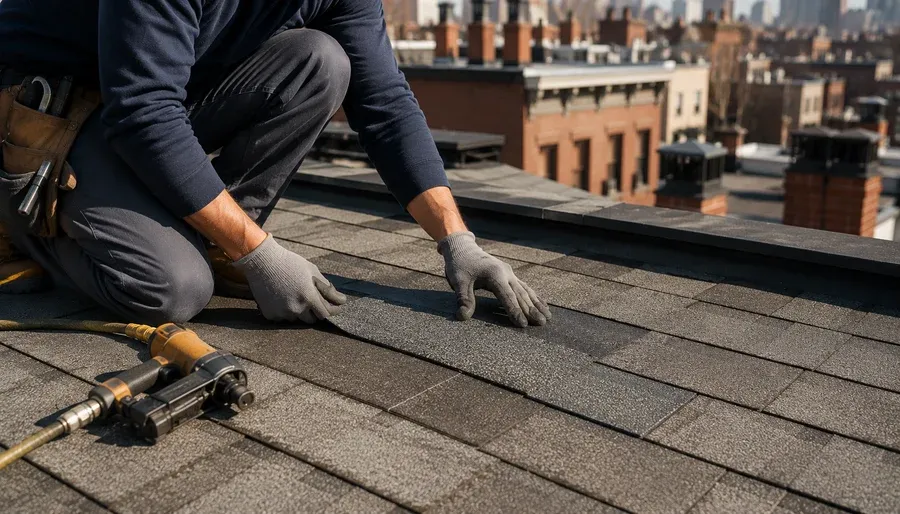
- Roof under 15 years old
- One isolated leak
- Storm or accident damage
- A single flashing issue
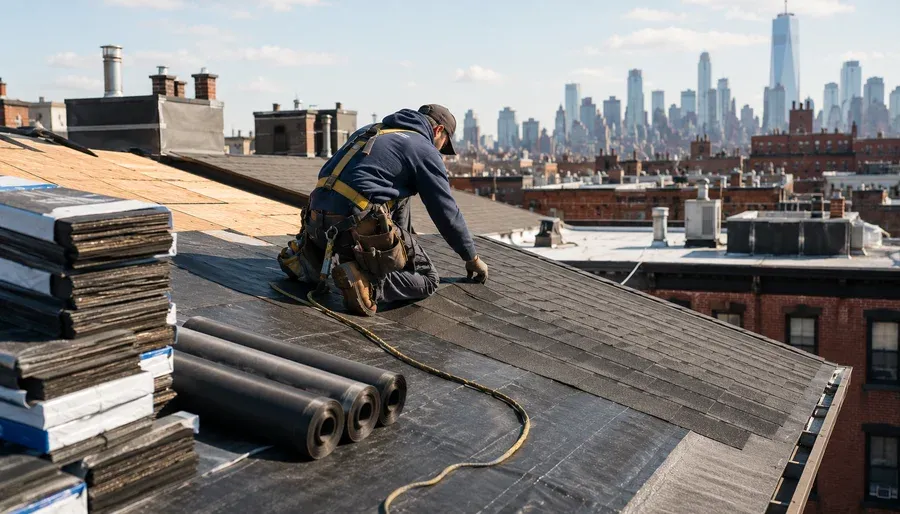
- Roof 25+ years old, or past its material's typical lifespan
- Multiple leaks or widespread wear
- Repeated patches on the same problem area
- Visible sagging or widespread deterioration
Typical roof lifespan by material
How your roof's material compares to its typical lifespan is one of the clearest signals in the checklist above.
What actually drives the price
Two quotes for what appears to be the same roof problem can still differ by a lot. The biggest price drivers are usually these.
- Roof type and material: a flat roof, a metal roof, and a pitched asphalt shingle roof all have different labor and material costs, and are not directly comparable to each other.
- Access and building height: a multi-story NYC building requires more setup, safety equipment, and time than a single-story house, which is a real cost factor pitched-roof cost guides written for other markets often do not account for.
- Extent of damage: a single, clearly located leak costs far less to fix than water damage that has spread under the roofing material into the deck below, which is not always visible from a walkthrough alone.
- Whether the roof deck or sheathing needs replacing: under NYC building rules, this is what actually triggers a Department of Buildings permit requirement, not the size of the visible problem, and filing adds real time and cost beyond the roofing work itself.
- Warranty tier: three real quotes gathered by one NYC homeowner for the same two-story roof came back at $14,000 (a shorter 10-year labor warranty), $23,000 (20-year warranty plus gutter and soffit work), and $25,000 (a national company's 50-year warranty). Same roof, same basic scope, an $11,000 spread driven almost entirely by warranty length and what else was bundled in.
- Timing: emergency or storm-season repairs typically cost more than a scheduled job booked in advance.
What moves the price, visualized
Why two quotes for what looks like the same roof job can differ by thousands. Longer bar = bigger effect.
How to find someone reputable, not just cheap
The lowest quote is not automatically the best one, and roofing has the same lead-marketplace problem as other home services: a "verified" badge on a lead-generation site is often just a paid listing fee, not a real check on who is actually getting on your roof.
- Ask whether the company is licensed, bonded, and insured, and ask for proof, not just a verbal yes. Roofing work carries real liability if something goes wrong, both for damage and for injury.
- Get a written scope of work, not just a price, before agreeing to anything: which areas are being repaired or replaced, the specific materials (shingle grade, underlayment, ice-and-water shield coverage), the warranty terms, and whether the quote already accounts for a DOB permit if one is needed. A generic checkbox proposal with no roof measurements listed, or a vague "personal guarantee" instead of a specific written workmanship warranty backed by the company, are both real signals to ask more questions before signing.
- Be skeptical of a quote based only on photos or a description over the phone for anything beyond a very small, clearly located repair, and be skeptical of a contractor who only assesses a roof from the ground. A legitimate roofer generally needs to physically get on the roof to price a repair or replacement accurately, especially if structural damage is a possibility.
- Be wary of a contractor who asks for full payment upfront, before any work begins. A reasonable structure is a partial deposit, often 25 to 50 percent, with the balance due on completion, and a contractor unwilling to work that way is a real red flag.
- Read a handful of specific, recent reviews rather than trusting a star average alone. A wall of generic five-star reviews with no detail is itself a signal worth noticing.
Finding someone you can actually trust with this
Once you know what a fair price looks like and whether you are actually looking at a repair or a bigger job, the next challenge is actually finding a provider who meets that bar.
On many lead-generation marketplaces, the "verification" you see is just a paid listing fee, not a real background or license check, and homeowners have reported being connected to a disconnected number or a company with real problems in its history. ServHom takes a different approach: real, ranked roofing businesses with their information shown up front, so you choose who to contact instead of being matched to whoever paid for the lead.
How to use this before you hire
Use the checks in this guide no matter who you end up hiring. When you are ready to compare providers directly, ServHom shows source-labeled business facts and money-blind ranking for NYC pros, so you can see why a business is listed, not just that it is.
FAQ
What is a fair price for a roof repair?
A standard roof repair (a leak, damaged flashing, or a small patch) typically runs $400 to $4,000 in NYC, with most straightforward jobs well under $2,000. The price depends heavily on how widespread the damage is and how accessible the roof is, so get a written scope before comparing two quotes directly.
Is it worth repairing an old roof?
It depends on the roof's age and how widespread the problem is. Asphalt shingle roofs typically last 20 to 30 years; a roof already near or past that range with a recurring or widespread problem is a real signal that a repair may only delay a full replacement by a year or two. A single, isolated issue on a newer roof is usually worth just repairing.
Will homeowners insurance cover a roof repair?
It depends on the cause. Sudden, specific damage from a storm or a fallen branch is often covered. Gradual wear, age-related deterioration, or damage from lack of maintenance typically is not. Get the damage documented and check your specific policy before assuming either way.
What is the 25% rule for roofing?
A widely circulated "25% rule" (damage over a quarter of a roof requires full replacement) is genuinely disputed outside NYC and does not reflect how NYC actually decides this. Under NYC building rules (1 RCNY 101-14), the real threshold is not an area percentage, it is whether the roof deck or sheathing needs replacing. A repair limited to the membrane, coverings, or insulation above the deck generally does not require a Department of Buildings permit; once the deck or sheathing itself needs replacing, a permit is required regardless of the size of the area involved.
How much does a new roof cost?
A full roof replacement in NYC typically runs $8,000 to $16,000 for a standard pitched asphalt shingle roof, and $11,000 to $38,000 for a flat roof, which is common on NYC brownstones and rowhouses. Metal roofing runs higher still, roughly $20,000 to $36,000. The exact price depends heavily on roof size, material, and access.