NYC price guide
How Much Does Brownstone Facade Restoration Cost in NYC?
One Brooklyn homeowner spent $26,000 keeping a brownstone facade looking sharp. Another got quoted well over $100,000 for what sounded like a similar job. The gap usually is not a scam, it is the difference between fixing what is actually deteriorated and resurfacing an entire facade that does not need it. Here is what restoration actually costs, and the real question to ask before you agree to either.
Quick Takeaways
- Minor brownstone repointing and patching commonly runs $10,000 to $30,000, while a standard facade overhaul on a typical 3-to-4-story townhome runs $70,000 to $100,000, and a full restoration on a larger or more deteriorated facade can exceed $100,000.
- NYC's Landmarks Preservation Commission explicitly prefers repairing or resurfacing only the deteriorated select areas of a brownstone facade (the stoop, base, or carved elements) over resurfacing the entire facade. A full-facade resurfacing is only permitted when LPC determines the brownstone is in extremely poor condition.
- This means a quote for a full facade resurfacing is not automatically the "more thorough" or safer option. If your building is landmarked, ask specifically whether the deterioration actually warrants a full resurfacing under LPC's own criteria, or whether targeted repair of the affected areas would be approved instead.
- Sandblasting is explicitly prohibited by LPC on historic masonry, since it can cause permanent damage and let water infiltrate the building. A contractor proposing it either does not do landmarks work regularly or is planning to do something that will not get approved.
- All resurfacing work must be undertaken by a qualified contractor under LPC's own rules, since it often requires skilled re-creation of decorative elements, not just patching a flat surface.
Why one brownstone facade job costs $26,000 and another costs $100,000+
A brownstone facade in rough shape is one of the most visible, most anxiety-inducing repairs a NYC homeowner can face, and the quotes reflect it: real numbers range from around $26,000 to keep a facade looking sharp, up to $100,000 or more for a fuller restoration. The instinct is to assume the higher number is the "correct," more thorough job. Often it is not. NYC's own landmarks rules explicitly favor fixing only what is actually deteriorated over resurfacing an entire facade, and knowing that distinction before you get quotes changes which number you should expect.
What brownstone facade restoration actually costs in NYC
The real range depends heavily on scope, and scope is exactly where most of the confusion comes from.
Minor repairs and repointing, patching isolated areas of deteriorated mortar or stone, commonly run $10,000 to $30,000. A standard facade overhaul, the kind most 3-to-4-story NYC townhomes need when the brownstone has widespread but not extreme deterioration, runs $70,000 to $100,000 based on real NYC-specific project data. Larger buildings, more technical work, or a facade in genuinely poor condition can push well past $100,000.
Real homeowner numbers show the same spread: one Brooklyn facade maintenance job ran $26,000, while Brownstoner forum posters have reported quotes from $35,000 to $60,000 for fuller restorations, and one homeowner noted a comparable job cost $25,000 fifteen years earlier. The job described, not just the building, is what explains most of the difference.
- Minor repairs and repointing (select areas only): $10,000 to $30,000.
- Standard facade overhaul (typical 3-to-4-story townhome): $70,000 to $100,000.
- Larger, more technical, or more deteriorated facades: $100,000 and up.
Cost by scope
Bars show the low-to-high range for each real scope, based on NYC-specific project data and real homeowner-reported quotes, reviewed August 2026.
Larger, more technical, or more severely deteriorated facades can exceed $100,000, with no reliable upper bound from the real sources reviewed for this guide, so that tier is not plotted above.
The question to ask before you accept either number
This is the part that actually explains why two quotes for "the same job" can be five times apart, and it comes straight from LPC's own rules, not a contractor's opinion.
- LPC can issue a permit to resurface select areas of a brownstone facade, such as the stoop, the base of the building, or elaborate carved details, when the deterioration in those specific areas warrants it. This is explicitly the more targeted, less expensive option.
- LPC states that an entire facade should not be resurfaced unless LPC determines the historic brownstone is in extremely poor condition overall. Full-facade resurfacing is the exception the rule is built around, not the default.
- If a contractor's first proposal is a full-facade resurfacing, ask directly: "Can you explain why this cannot be repaired selectively?" A contractor doing real landmarks work should be able to point to actual conditions that rule out the targeted option, not just quote the bigger job by default.
- All resurfacing work, whether select-area or full-facade, must be undertaken by a qualified contractor under LPC's own criteria, since it often requires skilled re-creation of decorative elements like cornices, lintels, and carved details, not just a flat patch.
| Signs pointing toward targeted repair | Signs pointing toward full restoration |
|---|---|
| Isolated cracks or a damaged stoop | Widespread delamination across the facade |
| Spalling limited to specific areas | Extensive water penetration throughout |
| A single loose cornice or carved detail | Multiple prior repairs that already failed |
What NYC landmarks rules actually require
Most brownstones sit in a historic district or are individually landmarked, which means this work is not just a masonry decision, it is also a permitting one.
- Repairs, restoration, or replacement of historic material must match the physical and aesthetic characteristics of the original, including design, detail, profile, dimension, material, texture, tooling, and color. This is the baseline LPC applies to nearly all facade work, not a special case.
- Sandblast cleaning is explicitly prohibited. It can cause permanent damage to historic materials and let water infiltrate the building. If a contractor proposes it, that is a real red flag, not a shortcut worth considering.
- A mortar analysis is typically required before a full repointing job on an individual landmark, to determine the historically appropriate replacement mortar rather than guessing at a match.
- Before assuming any of this applies, confirm whether your specific building is a designated landmark or sits within a historic district using the Discover NYC Landmarks map. Not every brownstone is under LPC jurisdiction, though a large share of NYC's brownstone stock is.
How to vet a contractor for landmarked facade work
This is not the same vetting bar as a standard repair job. Landmarks work has its own real, checkable competence signals.
- Ask for examples of prior LPC-approved work, specifically brownstone or masonry facade projects, not just general contracting experience. LPC's own rules require the craftsmanship to actually match historic materials, which is a real skill gap between contractors.
- If your building needs a permit, ask who is preparing the application materials (conditions statement, material specifications, color samples) and whether they have filed through LPC's Portico system before. A contractor unfamiliar with this process can add real delay.
- Get a second opinion specifically on scope, select-area repair versus full-facade resurfacing, before accepting either quote, given how much that one decision changes the total cost.
- On any lead-generation marketplace, a "verified" badge is often just a paid listing fee, not a real check on licensing or landmarks experience. Money-blind ranking means no business can pay to appear higher in results, on ServHom or anywhere it operates that way, so what you see reflects real signals, not who paid the most.
Finding someone you can actually trust with this
Once you know the real cost range and the scope question that actually drives it, the next challenge is finding a mason who can do both the craftsmanship and the landmarks paperwork correctly.
On many lead-generation marketplaces, the same request gets sent to several competing companies at once, and the homeowner has no real way to check who actually has landmarks experience before the calls start coming in. ServHom takes a different approach: you see real, ranked masonry businesses with their information shown up front, and you review and choose who to contact yourself.
How to use this before you hire
Use the checks in this guide no matter who you end up hiring. When you are ready to compare providers directly, ServHom shows source-labeled business facts and money-blind ranking for NYC pros, so you can see why a business is listed, not just that it is.
FAQ
How much does it cost to renovate a brownstone facade in NYC?
Minor repairs and repointing of select deteriorated areas commonly run $10,000 to $30,000. A standard facade overhaul on a typical 3-to-4-story townhome runs $70,000 to $100,000, and larger or more deteriorated facades can exceed $100,000. The real driver is scope, not just the building's size.
What are common brownstone problems?
Brownstone is a soft, porous sandstone that is very susceptible to water infiltration, spalling (surface flaking), and delamination over time, especially where prior repairs used incompatible, overly hard materials. Deterioration is often concentrated at the stoop, window sills, cornices, and other projecting elements rather than spread evenly across the facade.
How do you restore brownstone?
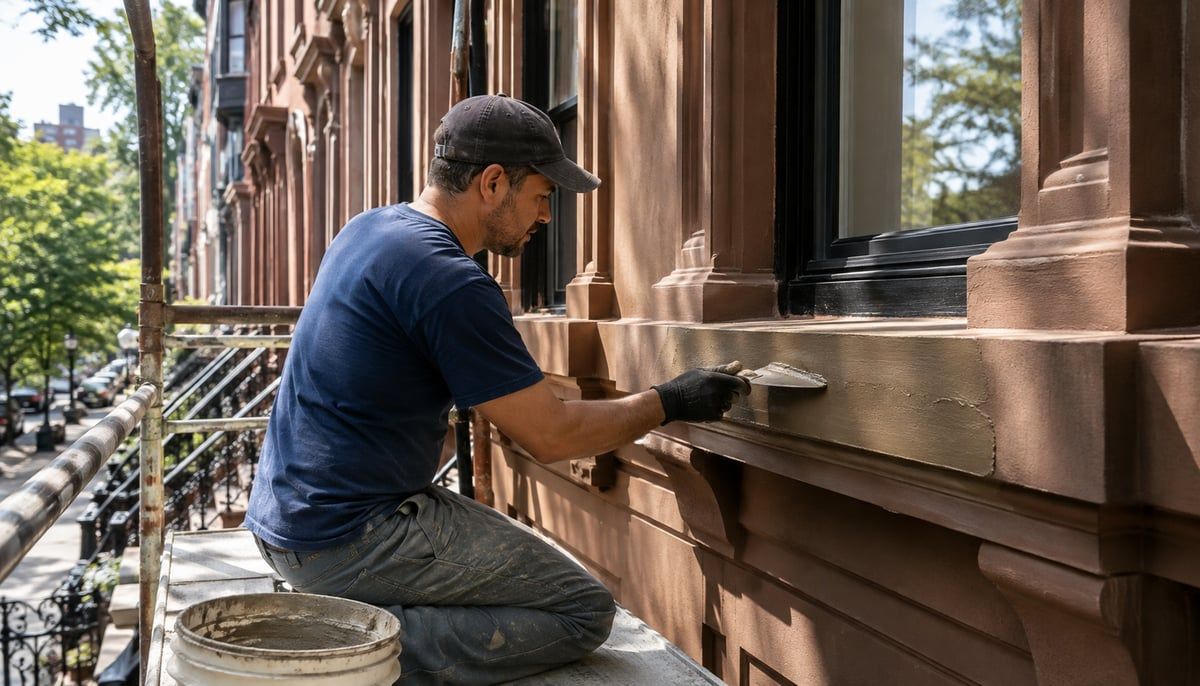
Deteriorated brownstone is typically cut back to sound material and resurfaced with a tinted cementitious patching compound that matches the original stone's color and texture, a process governed by NYC landmarks rules if the building is designated. LPC generally prefers restoring only the genuinely deteriorated areas rather than resurfacing an entire facade unless the whole facade is in extremely poor condition.
Is sandblasting allowed on a brownstone facade in NYC?
No. NYC's Landmarks Preservation Commission explicitly prohibits sandblast cleaning on historic masonry, since it can cause permanent damage to the material and allow water to infiltrate the building. A contractor proposing sandblasting on a landmarked brownstone is proposing something that will not be approved.