NYC price guide
How Much Does Tree Trimming Cost in NYC?
Branches scraping the roof, hanging low over the sidewalk, or crowding a neighbor's yard can turn a routine trim into a surprisingly expensive job, and the quotes that come back can look nothing alike for what sounds like the same tree. Here is what tree trimming actually costs in NYC by size, and the question worth asking before you call anyone: is this even something you have to pay for?
Quick Takeaways
- Trimming a small NYC tree (under 25 ft) typically costs $200 to $500; a large tree (over 50 ft) can run $800 to $2,200, per real 2026 NYC-specific pricing data.
- Difficult access, crane or rooftop rigging, or traffic control can add $500 to $2,000 to the base price. Trimming in peak summer can add another 10 to 20 percent versus off-season scheduling.
- NYC Parks does not take requests for routine street-tree pruning, but does prune street trees on a rotating cycle described in City Council testimony as roughly every seven years, and accepts free 311 requests for specific problems like dead or damaged branches, blocked sidewalks or signs, property damage, or branches hitting power lines.
- Pruning or trimming a street tree, whether you hire someone or do it yourself, requires a Tree Work Permit from NYC Parks, and the requirement also covers any work within 50 feet of a street tree, even on private property.
- In New York, courts recognize a self-help right to trim a neighbor's branches that cross onto your property, up to the property line, but the right covers ordinary trimming only, not entering their property or injuring the tree.
- Get at least 3 written quotes describing the same scope of work. Ask for proof of insurance and consider an ISA-certified arborist for significant work, and be wary of any company that pitches "topping" a tree.
- On ServHom no tree service can pay to rank higher, and we surface trust signals where we have them.
The real decision: does this even need a professional?
It is usually a slow-building annoyance rather than an emergency. A branch has been scraping the roof for a season, a limb is crowding the property line, or something is finally blocking a window or a walkway enough that it has to get dealt with. So you call around for quotes, and the numbers that come back can be wildly different for what sounds like the exact same tree.
That gap is not automatically someone trying to take advantage of you. Trimming has real variables, size, how much actually needs to come off, and access, that move the price more than almost anything else. But before comparing a single number, there is a question worth two minutes: is this tree actually yours to pay for in the first place?
What tree trimming actually costs in NYC
Trimming a small NYC tree, under 25 feet, typically runs $200 to $500. A large tree over 50 feet can run $800 to $2,200. Citywide, homeowners typically spend $304 to $2,027, averaging around $518, according to Angi's real NYC-specific 2026 pricing data, not a national average relabeled for the city. NYC's tight lots, overhead utility lines, and dense canopy genuinely push prices above what the same job would cost in most other US markets.
Some NYC crews price by the hour instead of by the tree. A separate New York-specific pricing source puts a two-person crew at $162 to $201 an hour, which is a useful cross-check for a smaller job rather than a different pricing system.
Where a given quote falls in that range comes down to size, access, and scope, covered next. Get quotes for the same described work before comparing numbers: one company pricing deadwood removal and light crown cleaning is not quoting the same job as one proposing a major structural reduction.
- Small tree, under 25 ft: $200 to $500.
- Medium tree, 25 to 50 ft: $450 to $1,000.
- Large tree, over 50 ft: $800 to $2,200.
- Difficult access requiring a crane, rooftop rigging, or traffic control: add $500 to $2,000 to the base price.
Cost by tree size
Real NYC-specific pricing, reviewed August 2026. Bars show the typical range per tree.
Difficult access requiring a crane, rooftop rigging, or traffic control is not shown here and can add $500 to $2,000 on top of any of these ranges.
What actually drives the price
Tree size is one of the biggest factors, but it is not the only one. For trimming specifically, how much of the crown needs to come off and how hard the tree is to reach can change a quote just as much as height does.
- Size: a real driver, and the starting point for most quotes.
- Scope: a light shaping trim costs far less than a major structural reduction or deadwood removal throughout the whole crown.
- Accessibility: a tree wedged between buildings, overhanging a roof, entangled with a fire escape, or without truck access takes longer and costs more. A job that needs a crane, rooftop rigging, or traffic control can add $500 to $2,000.
- Health and species: storm damage, pest issues, or disease can require an added arborist inspection or treatment, commonly $100 to $350 or more on top of the trim itself. If your tree is a protected species, you will need permission from the City before trimming or removing it.
- Time of year: late winter through early spring, before new growth, is typically the cheapest and easiest time to schedule. Trimming during peak summer, when crews are busiest, can add 10 to 20 percent to the price.
- Number of trees: most companies discount 5 to 15 percent per additional tree once a crew is already on site.
- Emergency timing: a branch that needs to come down right now, especially after a storm, costs more than the same job scheduled a week out. A branch actively threatening a person, structure, or utility line is different from a routine overgrown branch. If it is an immediate threat to life, call 911, not a contractor. If branches are impeding a power line, contact Con Edison before anyone starts work.
- Whether the tree is a City street tree: for some readers, the real driver of price is whether you need to pay a private company at all. See the process section below.
How the process actually works
Before you call a private company, there is a step worth two minutes: find out whether the tree is a City street tree, since NYC Parks might already have this covered.
NYC Parks prunes a portion of street trees every year through its block-pruning program, described in City Council testimony as roughly a seven-year cycle per community district, but NYC311 is explicit that it does not accept requests for routine maintenance of a street tree just because it looks overgrown. What it does accept, for free, is a 311 request when the branches are dead or damaged, blocking a street light, sign, or signal, blocking a street or sidewalk, causing property damage, or hitting power or phone lines. If your situation matches one of those, that is worth filing before you pay anyone.
- Have these ready before you ask for quotes: whether the tree is private or a City street tree, its approximate height, exactly what needs trimming, whether it is near a building, power line, sidewalk, or road, and whether there is room for a bucket truck.
- Send the same description and photos to at least 3 companies. One company pricing light crown cleaning and another pricing a major reduction are not comparable quotes, even for the same tree.
- 1Figure out whether the tree is a private tree (fully on your own lot) or a City street tree (the strip of dirt between the sidewalk and curb). This is the same distinction that matters for tree removal.
- 2If it is a street tree with a specific, qualifying problem, file a free 311 request. Otherwise, it will be handled on the City's own block-pruning schedule, not on request.
- 3If it is a private tree, or the problem does not qualify for a 311 request, or you want it done sooner than the City's own schedule, call private companies for quotes on the same described scope.
- 4The estimator confirms the scope in writing: light trim, structural reduction, deadwood removal, and whether debris hauling is included.
- 5If the tree is a street tree or the work is within 50 feet of one, a reputable company will handle applying for a Tree Work Permit from NYC Parks before scheduling the job, the same permit requirement that covers removal.
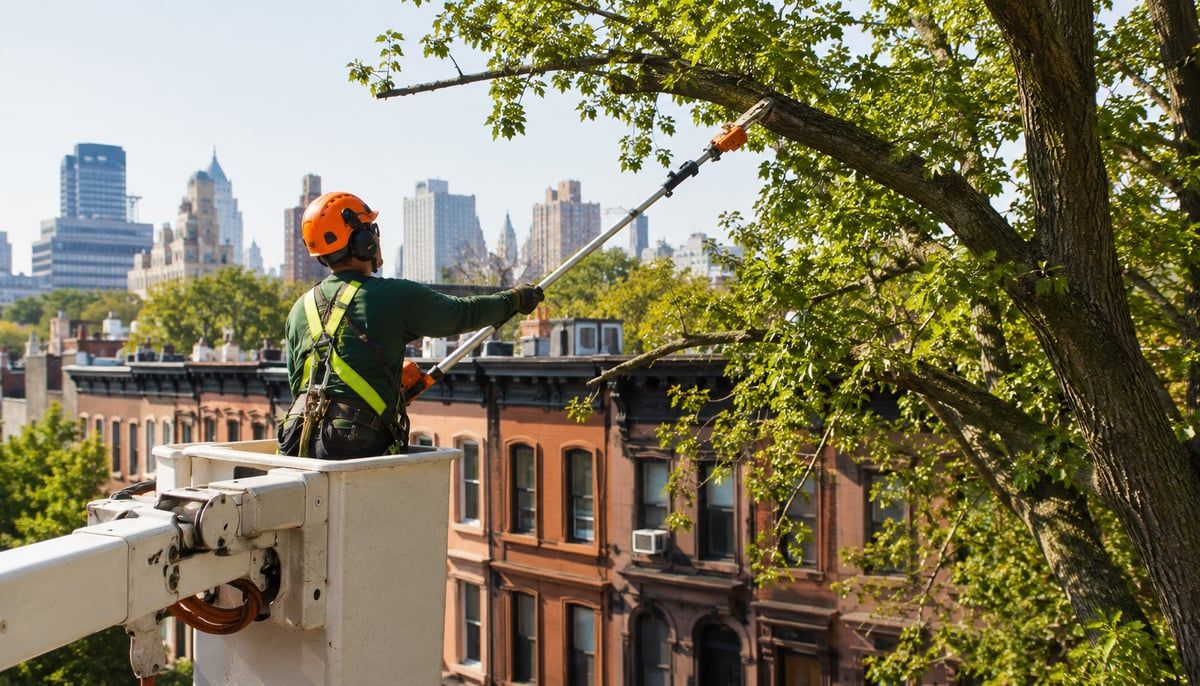
- 6On the day of the job, the crew trims from the ground or, for taller work, from a bucket truck or by climbing, then hauls debris if that was part of the scope.
- 7You get a final invoice matching the written scope. Any changes discovered on site should be discussed with you before the price changes.
How to vet a tree service before you hire
Tree work is physically dangerous, and insurance matters more here than in almost any other home service. NY State DEC's own guidance for hiring a tree service warns that under some circumstances you could be held financially responsible if an uninsured worker is hurt on your property, or if the crew damages a neighbor's property. A company that will not show proof of insurance, or whose policy does not check out with the insurer directly, is a real red flag, not a minor inconvenience.
For a street tree permit specifically, NYC requires the company to carry proper insurance and to have at least one certified arborist, or someone with equivalent experience Parks has approved, on the job.
- Ask for proof of general liability insurance and workers compensation before anyone climbs the tree, and call the insurer to confirm the policy is current.
- Consider an ISA-certified arborist for significant work, someone certified by the International Society of Arboriculture, especially for a large tree or a structural reduction rather than a light trim.
- Be cautious of a company that pitches "topping," cutting the entire top of the tree back just to shorten it. NY State DEC specifically warns that topping is a poor practice that injures trees and creates weak branches more prone to failure.
- Get the scope in writing: what is being trimmed, how much is coming off, whether debris hauling is included, and whether a permit is needed and who is filing it.
- Be cautious of a company that shows up unsolicited after a storm offering an on-the-spot deal. Reputable local companies exist, but storm-chasing crews with no local address are a well-documented source of bad work.
Finding a tree service you can actually trust
Most ways to find a tree service either sell your contact details to a list of companies who all call at once, or rank whoever pays the most for placement. ServHom does neither. No tree service can pay to rank higher on ServHom, ever, and we surface the trust signals we have on file so you can compare companies on something other than who called first.
Once you know what a fair price looks like, whether the City might do the work for free, and whether a permit is needed, the next step is finding a company that is actually accountable, not just first to answer the phone.
How to use this before you hire
Use the checks in this guide no matter who you end up hiring. When you are ready to compare providers directly, ServHom shows source-labeled business facts and money-blind ranking for NYC pros, so you can see why a business is listed, not just that it is.
FAQ
How much does tree trimming cost in NYC?
It depends mostly on the tree's size. A small tree under 25 ft typically runs $200 to $500, a medium tree (25 to 50 ft) runs $450 to $1,000, and a large tree over 50 ft runs $800 to $2,200, per real 2026 NYC-specific pricing data. Difficult access, like a crane or rooftop rigging, can add $500 to $2,000 on top of that.
How do I estimate what a tree trimming job should cost?
Start with the tree's height and how much of the crown actually needs to come off, since those drive most of the base price. Then check for anything that adds to it: hard access (tight yard, near power lines, no truck access), storm or pest damage needing extra inspection, and whether it is peak season. Get quotes from at least 3 companies using the same description and photos, since a light trim and a major structural reduction on the same tree are not the same job or the same price.
How can I request a tree pruned in NYC?
NYC Parks does not take requests for routine maintenance of a street tree just because it looks overgrown; that gets handled on the City's own rotating block-pruning schedule. What Parks does accept for free through 311 is a request for a specific problem: dead or damaged branches, branches blocking a street light, sign, or signal, blocking a street or sidewalk, causing property damage, or hitting power or phone lines. Parks does not perform work on trees located on private property, so a private tree needs a private tree service.
Do I need a permit to trim a tree in NYC?
If it is a City street tree, yes. NYC Parks' Tree Work Permit requirement explicitly covers pruning, not just removal, and also applies to any work within 50 feet of a street tree, even if that work happens on private property. Unpermitted work on a street tree is illegal under NYC Administrative Code Section 18-129: general violations are misdemeanors with fines up to $1,000, while removing a tree without a permit or damaging one carries fines up to $15,000 and up to a year in jail. A tree standing entirely on your own private property generally does not need a Parks permit, though other property-specific rules can still apply.
Can you trim your neighbor's tree if the branches cross your property line?
Generally yes, on your side of the property line only. New York courts recognize a self-help right for a property owner to trim ordinary branches that overhang from a neighbor's tree onto their property, without entering the neighbor's land (Coffey v Gerelli, 2017). That right covers ordinary trimming and clipping; it does not extend to seriously injuring the tree. A specific dispute can still turn on the facts, so treat this as a general starting point, not legal advice for your situation.