NYC price guide
How Much Does Smart Thermostat Installation Cost in NYC?
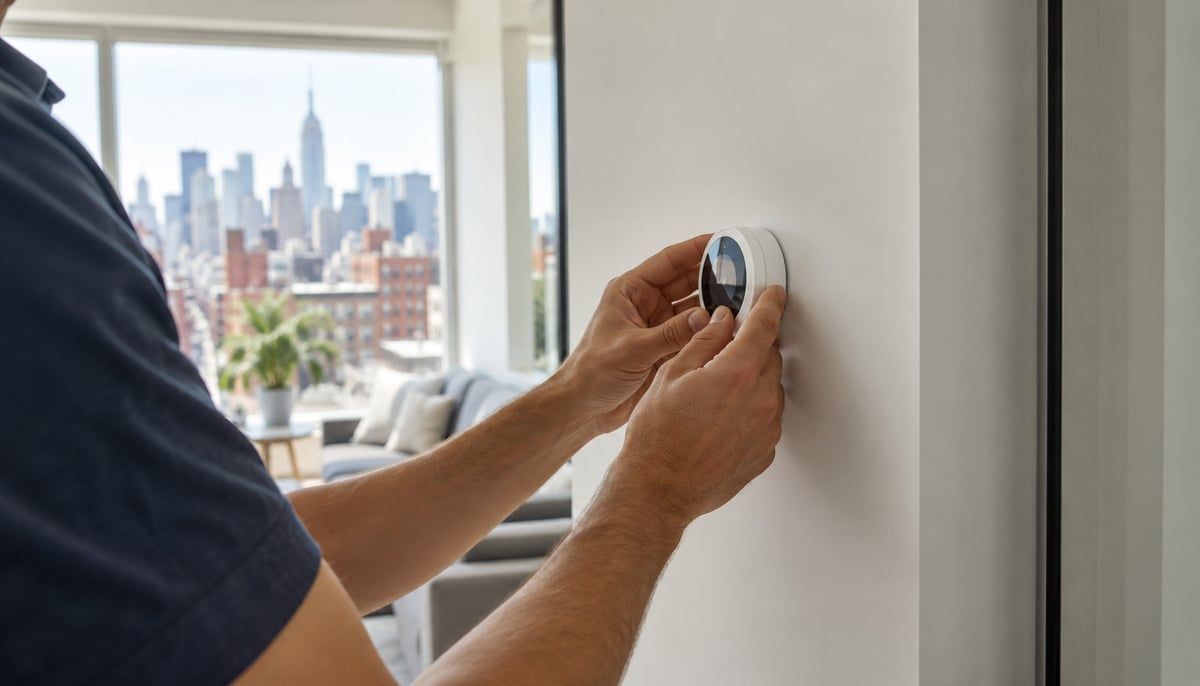
Buying the thermostat yourself does not automatically make installation cheap, and the hardware is often not the expensive part. Here is what smart thermostat installation actually costs in NYC, what to check before you buy one, and the precise, narrow reason the wiring itself can legally require a licensed electrician even when the swap looks like a five-minute job.
Quick Takeaways
- A typical WiFi smart thermostat installation in NYC costs $250 to $500 when the existing wiring can support it, and $300 to $600 if a new C-wire has to be run. Multi-zone systems and less common wiring can push the total to $1,000 or more.
- A basic non-programmable thermostat swap is cheaper across the board, commonly $100 to $200.
- Check compatibility before you buy. Proprietary systems, millivolt heaters, and electric baseboard or other high-voltage systems are generally not compatible with a standard WiFi smart thermostat, according to Google's own Nest compatibility documentation.
- A C-wire is not a strict pass or fail test. Some systems can power a smart thermostat without one, others need one or a manufacturer power accessory, and having one does not by itself guarantee your system is otherwise compatible.
- Con Edison pays an $85 enrollment rebate on specific eligible smart thermostat models, but only if you have central air conditioning, a real, narrow eligibility rule worth checking before assuming any smart thermostat qualifies.
- NYC's electrical code carves out the thermostat's specific low-voltage connection, the one that interfaces with a heat or power control circuit, as requiring a licensed master or special electrician, separate from the broader low-voltage work a wider range of qualified people can otherwise do.
- On ServHom no installer can pay to rank higher, and we surface trust signals where we have them.
The real decision: is this actually worth paying someone for
Buying the thermostat yourself does not automatically make installation cheap. A homeowner on Reddit described exactly that: their own contractor charged them to install a thermostat they had already bought online, a small part that turned into a real line item on an invoice. The replies split into two camps, people who said a thermostat swap is a five-minute job anyone can do watching a YouTube video, and people who had opened the wall behind their old thermostat and found wiring that did not match any tutorial they had seen.
Both camps are right, just about different situations. A straightforward, like-for-like swap onto wires that are already there and already labeled is genuinely simple. Adding a new wire where none exists, working inside an older building's control wiring, or discovering your heating system is not actually compatible with the thermostat you already bought is a different job entirely. The real question is not whether this is normally cheap or expensive, it is which of those jobs you actually have, and often the hardware itself is not the expensive part: what you are paying for is compatibility checking, wiring, and, in NYC specifically, whether the connection is legally something you are meant to do yourself.
What smart thermostat installation actually costs in NYC
A typical WiFi smart thermostat installation in NYC costs $250 to $500 when the existing wiring can support it. If a new C-wire or other wiring work is needed, expect $300 to $600. Multi-zone systems and less common wiring can push the total to $1,000 or more. A basic non-smart digital thermostat is cheaper across the board, commonly $100 to $200.
These figures are editorial estimates, not a statistically meaningful NYC market average. ServHom does not yet have enough submitted smart-home price reports of its own to publish a fair-price benchmark for this service. They come from a real, itemized NYC HVAC company's own published pricing (Pro's HVAC NYC, reviewed August 2026, pricing reviewed by a Professional Engineer on staff), cross-checked against a real NYC electrical and smart-home installer's own stated minimum (asap.repair) and national data from Homewyse and Mysa. Treat them as planning ranges, not a fixed quote.
- Basic non-programmable digital thermostat, supply and install: $100 to $200.
- Programmable thermostat with 7-day scheduling: $150 to $300.
- WiFi smart thermostat (Nest, Ecobee, or similar) where the existing wiring can already power it: $250 to $500.
- The same WiFi smart thermostat where a new C-wire has to be run, common in older NYC buildings that were never wired for one: $300 to $600.
- Multi-zone setup, multiple thermostats controlling separate zones: $400 to $1,000.
- Line-voltage thermostat for electric baseboard heat, a genuinely different product and wiring type, not a cheaper version of the same job: $150 to $350.
- If you already bought the thermostat yourself, do not assume installation should cost far less than the ranges above. A real NYC electrical and smart-home installer states a $150 minimum for a simple single-device setup, and that minimum can climb if the technician has to diagnose a compatibility issue, run a new C-wire, or troubleshoot wiring that does not match what the thermostat's own setup guide expects. You are paying for the visit, the diagnosis, and the labor, not just the part.
- Con Edison pays an $85 enrollment rebate for specific eligible WiFi thermostats (Amazon Smart Thermostat, Sensi, Honeywell Total Connect Comfort, and Honeywell Home T5/T6 models, as of this writing). Starting in the third year, participants can also earn $25 a year if they participate in at least half of the program's scheduled event hours, which let Con Edison make small, temporary adjustments to your air conditioning during weekday peak hours between May and September. It requires central air conditioning to enroll at all, it is not a general rebate for buying any smart thermostat, and it is a separate reward from the purchase or installation cost, not a discount at checkout.
| Situation | Complexity | Approx. cost |
|---|---|---|
| Replace a basic thermostat with the same type | Low | $100 to $200 |
| Install a WiFi smart thermostat, compatible existing wiring | Moderate | $250 to $500 |
| WiFi smart thermostat, new C-wire needed | Moderate to high | $300 to $600 |
| Multiple zones | High | $400 to $1,000+ |
| Electric baseboard or other high-voltage system | Different product entirely | $150 to $350 |
| Unknown or proprietary wiring | Diagnose first | Quote required |
Installed cost, by thermostat type
Bars show the low-to-high range, hardware and labor combined, for NYC installation.
Before you buy a smart thermostat
Do not buy the thermostat before checking whether your heating and cooling system can actually use it. This is the step most cost guides skip, and it is the real reason some installations go smoothly while others turn into a multi-visit troubleshooting job.
Start with what kind of system you have: forced-air furnace, central air conditioning, a boiler with radiators, steam, a heat pump, electric baseboard, a PTAC, a fan-coil unit, or a multi-zone setup. Google's own Nest compatibility documentation confirms most standard 24-volt heating and cooling systems work with a WiFi smart thermostat, but three system types generally do not: proprietary systems (non-standard wire labels, or only two wires despite having both heat and cooling), millivolt heaters (typically wall or floor heaters that cannot deliver enough power), and high-voltage systems, which in practice usually means electric baseboard or other radiant electric heat.
A C-wire is worth understanding on its own terms, not as a pass or fail test. Google's own documentation describes it as a wire that provides constant power to the thermostat and does not itself control heating or cooling, and notes that some systems can already power a smart thermostat through their existing heating and cooling wires with no C-wire at all, while others need one or a manufacturer power accessory. Having a C-wire already in place makes installation easier, but it does not by itself guarantee your specific system and thermostat model are compatible, and not having one does not automatically rule a smart thermostat out either.
NYC apartment buildings add a wrinkle most national cost guides never mention. Not every NYC apartment has a conventional forced-air-and-central-AC setup: PTACs, fan-coil units, and building-wide steam or hydronic systems are common, especially in prewar and mid-rise buildings, and a thermostat that works with a standard system may not work with building-controlled equipment at all. If your unit's heat or cooling is part of a building-wide system rather than something you control directly, check with building management or a pro before buying a thermostat that may not be compatible with what your unit actually has (see our separate guide to PTAC replacement cost in NYC if that is your system).
The most reliable way to check before you disconnect anything: take a photo of your current thermostat's wiring before removing it, and if the labels at the thermostat end are unclear, check your system's control board, usually inside the furnace or HVAC unit itself, where the wire terminals are typically labeled more reliably.
- A smart thermostat may not be worth installing yet if your heating or cooling system is one of the incompatible types above and would need a rewiring project just to use one.
- It may also not be worth it if you rent and cannot modify the system, your building controls heating or cooling centrally and you have no thermostat of your own to replace, your unit uses a proprietary or building-specific system with no available adapter, or you are planning to replace your HVAC system soon anyway, since a new system often comes with its own compatible thermostat.
What actually drives the price
Two quotes for what sounds like the exact same thermostat swap can differ by hundreds of dollars. These are the real factors behind that gap.
- Whether your existing wiring can power the thermostat: this is the single biggest swing, and it is not simply about whether a C-wire is present. Some smart thermostats can run off existing heating and cooling wires with no C-wire at all; others need one or a power accessory. Running a new C-wire where nothing else can substitute for it is real additional labor, especially in a prewar building with plaster walls or limited access.
- Heating and cooling system type: forced-air, radiant, baseboard, and steam systems all wire differently, and some, like a proprietary building system or a high-voltage electric baseboard setup, are not compatible with a standard smart thermostat at all, a compatibility problem no amount of labor solves, only a different product does.
- Number of zones: a multi-zone setup means multiple thermostats and more wiring to coordinate, not a simple multiple of a single-zone price.
- Thermostat type and features: a basic digital swap is the cheapest tier; WiFi, learning features, and multi-room sensors push the hardware cost up on top of labor.
- Who performs the work: a straightforward thermostat swap can look like a small service call, but NYC's electrical code treats certain thermostat control-circuit connections differently from ordinary low-voltage wiring, described in the next section, which can affect who is qualified to do the work and therefore the labor price.
- Building access: a doorman building, a co-op requiring advance notice, or a hard-to-reach thermostat location can add real scheduling and labor time that has nothing to do with the thermostat itself.
What moves the price
Why two quotes for what sounds like the same swap can differ by hundreds of dollars. Longer bar = bigger effect.
When the wiring itself actually needs a licensed electrician
NYC's baseline rule is broad: Admin Code section 28-429.1 makes it unlawful to perform electrical work unless you are a licensed master electrician, or working under one's direct supervision, with two narrow exceptions carved out elsewhere in the code: low-voltage work performed by a qualified person, and work performed by a licensed special electrician.
One of those exceptions, section 28-105.4.7, Low Voltage Electrical Work (amended by Local Law 128 of 2024, effective December 21, 2025), generally exempts wiring under 50 volts used for signaling, communication, alarm, and data-transmission circuits from needing an electrical permit at all, as long as a licensed master electrician, special electrician, or qualified person does the work. A basic intercom or low-voltage doorbell wire often falls under exactly that lighter-touch category.
NYC's electrical code treats thermostat control wiring differently from that general low-voltage rule. The same section specifically excludes any wiring that connects to or interfaces with a control circuit that activates a light, heat, or power circuit from the broader qualified-person allowance, naming that exception on its own. That exception is directly relevant to a thermostat, since a thermostat is the low-voltage control point that tells a boiler, furnace, or air conditioner to turn on. For that reason, do not assume a thermostat's low voltage automatically means any qualified person can make the connection: when the installation involves making or modifying that control-circuit connection, the code calls for a licensed master electrician or special electrician specifically, not the broader qualified-person category.
In practice, plenty of homeowners swap a like-for-like smart thermostat onto the same two or three labeled wires themselves, and manufacturers design their installation guides assuming exactly that. Running a new C-wire, working inside an older building's control wiring, or anything beyond reconnecting existing labeled wires to the same terminals is a more involved job. If you are unsure which category your job falls into, ask whoever you hire directly whether they hold the license this type of connection requires, or confirm with NYC's Department of Buildings, rather than assuming a small device on the wall means small legal stakes.
How to vet an installer before you hire
This is one of those jobs where the real question is not just whether the price is fair, it is whether the person doing the actual wire connection has standing to do it.
- If the job involves anything beyond reconnecting the exact same labeled wires to the same terminals, ask specifically who is making that connection and whether they hold a NYC electrician license, then look the license up yourself rather than taking their word for it.
- A real quote should spell out: the thermostat model and whether you are supplying it yourself, whether a new C-wire or power accessory is needed, any electrical work involved, a compatibility check if your system is unusual, disposal of the old thermostat, app and WiFi setup, and a test of your heating and cooling before the technician leaves. A number with no scope attached is not really a quote.
- Ask what happens if the wiring behind your old thermostat turns out to be undocumented, damaged, or not a standard configuration once the wall plate comes off. That is common enough in older NYC buildings to ask about upfront.
- Many lead-generation sites treat "verified" as little more than a paid listing fee, not an actual license check. ServHom's license verification is pulled from a public record, not a badge a business paid to display.
Finding an installer you can trust
Once you know whether your own thermostat swap is genuinely a simple job or a licensed-electrician connection, the next challenge is finding someone accountable to do it, not just first to answer the phone. Most ways to find one either sell your contact details to a list of companies who all reach out at once, or rank whoever pays the most for placement.
ServHom does neither. No installer can pay to rank higher on ServHom, ever, and we surface the trust signals we have on file so you can compare installers on something other than who called first.
How to use this before you hire
Use the checks in this guide no matter who you end up hiring. When you are ready to compare providers directly, ServHom shows source-labeled business facts and money-blind ranking for NYC pros, so you can see why a business is listed, not just that it is.
FAQ
How much should it cost to install a smart thermostat?
In NYC, a WiFi smart thermostat installation commonly runs $250 to $500 when your existing wiring can support it, or $300 to $600 if a new C-wire has to be run. A basic non-smart digital thermostat is cheaper, commonly $100 to $200. Multi-zone systems and less common wiring can push the total to $1,000 or more.
What does installation cost if I already own the thermostat?
Do not assume it should cost far less. A real NYC electrical and smart-home installer states a $150 minimum for a simple single-device setup, and that can climb if the technician has to diagnose a compatibility issue or deal with wiring your thermostat's setup guide did not expect. You are paying for the visit, the diagnosis, and the labor, not the hardware.
Does an electrician need to install a smart thermostat?
For the specific low-voltage connection that links the thermostat to your heating or cooling system, NYC's Admin Code carves out that exact type of connection as one requiring a licensed master or special electrician, not the broader qualified-person category a wider range of low-voltage work otherwise allows. A simple like-for-like swap onto the same existing wires is commonly done by homeowners themselves, but do not assume that means the connection is automatically exempt from NYC's licensing rules.
Does a smart thermostat work with electric baseboard heat?
Not directly. Electric baseboard heat and other high-voltage radiant systems are one of the system types Google's own Nest compatibility documentation lists as incompatible with a standard WiFi smart thermostat, along with proprietary and millivolt systems. These systems use line-voltage thermostats instead, commonly $150 to $350 installed, a genuinely different product and wiring type, not a cheaper version of the same job.
Is it worth installing a smart thermostat?
ENERGY STAR's own certification data puts average savings at approximately 8 percent of heating and cooling bills, or about $50 a year, with the potential for more depending on climate and how the system is used. At that average, a $250 installation would take roughly five years to pay back through energy savings alone, and a $500 installation roughly ten years. Con Edison's real $85 enrollment rebate on specific eligible models shortens that further if you qualify. Actual savings and payback vary by household.
How can I tell if my thermostat needs a C-wire?
Look at the wiring behind your existing thermostat: a labeled "C" terminal with a wire already connected to it means you have one. But a C-wire is not a strict requirement for every smart thermostat, since some systems can power one through their existing heating and cooling wires without it, and having a C-wire does not by itself guarantee your system is otherwise compatible. Take a photo of the wiring before you disconnect anything, and check your system's control board if the labels at the thermostat end are unclear.