NYC price guide
How Much Does Kitchen Cabinet Refacing Cost in NYC?
One quote came back at $2,000, another at $9,000, and a third at $18,000, all for the same dated oak kitchen. They were not pricing the same job. Here is the real difference between cabinet refacing and refinishing, and what each one actually costs in NYC.
Quick Takeaways
- Cabinet refacing and cabinet refinishing are two different jobs, not two price tiers of the same job. Refacing (new doors and drawer fronts plus veneer over the existing boxes) averages $8,034 in NYC per Angi, typically $5,193 to $10,938. Refinishing (stripping and repainting the existing doors and boxes in place) typically runs $1,500 to $6,000 nationally.
- NYC's own Department of Buildings lists installing new cabinets, along with painting, as work that does not need a DOB permit, but the contractor doing it generally must still hold a DCWP Home Improvement Contractor license for work totaling more than $200.
- Material choice moves refacing price the most: laminate or thermofoil doors sit toward the low end, real wood veneer and custom doors can push a job to $25,000 or more.
- If refinishing involves sanding or stripping old paint down to bare wood in a pre-1978 NYC apartment, that can trigger the EPA's lead-safe renovation rule once it disturbs more than six square feet of painted surface in the room, a threshold a full kitchen of cabinet doors adds up to quickly even though each door looks small on its own.
- Get at least three written quotes and confirm which job each one is actually scoped for before comparing numbers side by side.
Why three quotes for the same kitchen can look nothing alike
The cabinets are structurally fine. The boxes are square, the drawers still glide, but the oak finish and brass hardware look stuck in a different decade, and a full gut renovation feels like overkill for that alone. So quotes go out, and the numbers that come back do not make sense next to each other: $2,000 from one company, $9,000 from another, $18,000 from a third, all supposedly for the same kitchen.
The reason is not that two of the three companies are ripping you off. "Cabinet refacing" and "cabinet refinishing" get used almost interchangeably in casual conversation, but they are different jobs with a real, structural price gap between them. Knowing which one you are actually being quoted, before you compare numbers, is what makes the rest of this decision make sense.
What refacing and refinishing actually cost in NYC
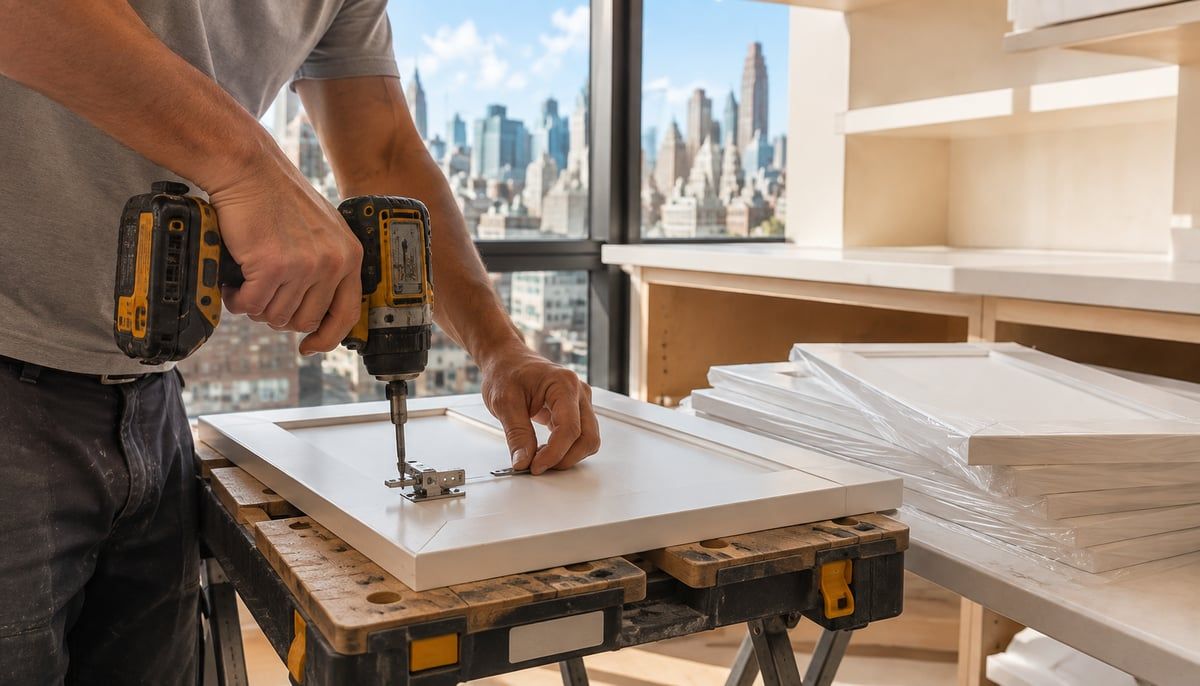
Refacing means the existing cabinet boxes stay in place, and new doors, new drawer fronts, and a matching veneer over the visible box surfaces get installed on top of them. It is real, sometimes substantial, remodeling work. Angi's real NYC-specific data puts the average full refacing project at $8,034, with most homeowners spending between $5,193 and $10,938. Nationally, refacing ranges more widely, from roughly $4,000 on the low end (laminate or thermofoil doors) to $25,000 or more for solid wood veneer and custom doors, a range corroborated across Home Depot, N-Hance, Redo Cabinet Refacing, and Kitchen Cabinet Kings, all reviewed August 2026.
Refinishing means the existing doors and boxes are stripped, sanded, and repainted or restained in place, with no new doors or veneer material. It is far closer to a specialized paint job than a remodel, and it prices accordingly: Thumbtack's own New York City market data puts this at $1,500 to $6,000 nationally, and Redo Cabinet Refacing's cost comparison corroborates a similar $1,500 to $10,000 range for larger kitchens. That is the real source of the confusing quote spread: a refinishing-only quote and a full-refacing quote can legitimately differ by 3 to 5 times for cabinets that look similarly dated from across the room.
Refacing vs. refinishing cost
These are two different jobs, not two sizes of the same job, and the two bars are not equally strong NYC data: refacing is a real NYC-specific average (Angi), while refinishing is a national benchmark (Thumbtack), reviewed August 2026, since no NYC-specific refinishing-only figure was found.
Full refacing projects with premium materials (solid wood veneer, custom doors) can run well past $10,938 nationally, sometimes to $25,000 or more, which is not shown above since it reflects a materials choice rather than the typical NYC range.
Reface, refinish, or replace?
Once the price gap makes sense, the actual decision usually comes down to the condition of what you already have, not just budget.
- Refinish if the boxes and doors are structurally sound and the layout works. You mainly dislike the color or finish, not the style of the doors themselves.
- Reface if the boxes are sound and the layout works, but you want a different door style, material, or color than a repaint can achieve.
- Replace (a full remodel, outside the scope of this guide) if the boxes are damaged or warped, you want to change the kitchen layout, or you are moving the sink, adding cabinets, or reconfiguring the space. Refacing and refinishing both keep the existing footprint exactly where it is.
What actually drives the price up or down
Once you know which job you are pricing, these are the factors that move the number within it.
- Material choice (refacing): laminate and thermofoil doors sit at the lower end, real wood veneer and solid wood custom doors sit at the higher end, and this single choice is usually the biggest swing factor in a refacing quote.
- Door and drawer count: a galley kitchen with 10 to 12 fronts costs less than an L-shaped kitchen with 20 or more, since both refacing and refinishing are commonly priced per door and drawer, not as a single flat fee.
- Box condition: a box with water damage under the sink or warping from an old dishwasher leak needs repair before refacing or refinishing can proceed, and that repair is typically quoted separately once the doors come off and the damage is visible.
- Hardware and soft-close upgrades: new hinges, pulls, and soft-close mechanisms are commonly quoted as an add-on to either job, not bundled in by default.
- Co-op and condo paperwork: getting a contractor approved for building access typically means a board letter and a certificate of insurance naming the building and managing agent as additional insureds, the same overhead that shows up on most contractor work in a managed NYC building.
| Door material | Relative cost | Typically best for |
|---|---|---|
| Thermofoil | $ | A budget-friendly, smooth, modern look, vinyl-wrapped over a substrate. |
| Laminate | $$ | A durable, wipeable surface at a moderate price, common in refacing kits. |
| Wood veneer | $$$ | A real wood look and grain, priced above laminate since it uses an actual wood layer. |
| Solid wood | $$$$ | A fully custom, premium door, the highest tier in both refacing and cabinet-replacement pricing. |
How the process actually works
Both jobs start the same way and diverge from there.
- 1An in-home visit to measure the kitchen, count doors and drawers, and assess box condition, which is also when a contractor should tell you plainly whether refacing or refinishing fits what you are asking for.
- 2For refacing, new doors and drawer fronts are typically built off-site to match the chosen material, while veneer is applied to the visible box surfaces either on-site or after the boxes are temporarily removed.
- 3For refinishing, doors are commonly removed and sprayed off-site in a shop or spray booth for a smoother, more even finish than on-site brushing or rolling can achieve, then reinstalled once dry.
- 4If box damage turns up once doors are off, that repair happens before refacing or refinishing continues, which is the most common source of a mid-project cost increase. Ask upfront whether box repairs are included or billed separately if found, since this is the single most common place a fixed-sounding price turns into a change order.
- 5A standard job runs 3 to 7 days depending on scope, and the kitchen is generally not usable for cooking during the active work.
What a cabinet refacing or refinishing quote should include
The opening problem in this guide, three wildly different numbers for what sounded like the same job, usually traces back to a quote that never spelled out its scope. A written quote worth comparing should itemize:
- Number of doors and drawer fronts covered
- Door and drawer front material (thermofoil, laminate, wood veneer, or solid wood)
- Veneer material for the box surfaces, for a refacing job
- Hardware, including whether soft-close hinges are included or an upgrade
- Box repair, and whether it is included or billed separately if found
- Removal and disposal of the old doors and materials
- Painting, staining, or finish coats, and how many
- Installation and estimated timeline
- Any warranty on materials or labor
- Whether the company will handle co-op or condo building insurance paperwork
What NYC actually requires, and how to vet a licensed pro
This is genuinely reassuring news for anyone worried a cabinet job will turn into a permit headache: NYC's own Department of Buildings lists installing new cabinets, right alongside painting, as work that does not require a DOB permit. That covers standard refacing and refinishing scope. It changes if the job also involves moving plumbing, electrical, or structural changes, which is a kitchen remodel question, not a cabinet-refresh one.
Permit-exempt does not mean license-exempt. For a straightforward cabinet installation, refacing, or refinishing project, the same DOB page is explicit that the contractor doing this work must still hold a Department of Consumer and Worker Protection Home Improvement Contractor (HIC) license, and DCWP's own License Search lets you check a specific business or individual's license status directly, free, with no login required.
If refinishing is the chosen job and the building predates 1978, ask specifically how the paid contractor plans to prep the old paint. The EPA's Renovation, Repair and Painting rule requires a lead-safe certified renovator on paid work that disturbs painted surfaces in housing built before 1978, unless the job qualifies for a narrow exemption for minor work that disturbs six square feet or less of painted surface per room. A full set of cabinet doors can add up past that threshold quickly, so it is worth confirming before work begins rather than assuming refinishing automatically qualifies for the exemption. Refacing typically involves lighter surface prep on the boxes than refinishing's stripping and sanding, so it is less likely to approach this threshold, but ask rather than assume either way.
On a lead-generation marketplace, a "verified" badge is often just a paid listing fee rather than a real check on licensing. ServHom's trust signals are built on an actual public-record license check, not a fee a business pays to display a badge.
Finding someone you can actually trust with this
Once you know which job you actually need and roughly what it should cost, the next challenge is finding a painter or refacing contractor who is licensed and will scope the job honestly instead of quoting whichever number gets the job signed.
On many lead-generation marketplaces, the same request gets sent to several competing companies at once, and the homeowner has no real way to check who is actually licensed before the calls start coming in. ServHom takes a different approach: you see real, ranked painting businesses with their information shown up front, and you review and choose who to contact yourself.
How to use this before you hire
Use the checks in this guide no matter who you end up hiring. When you are ready to compare providers directly, ServHom shows source-labeled business facts and money-blind ranking for NYC pros, so you can see why a business is listed, not just that it is.
FAQ
Is it cheaper to reface or replace cabinets?
Refacing is usually cheaper than a full cabinet replacement, since the existing boxes stay in place and only the doors, drawer fronts, and visible surfaces are replaced. That gap narrows with premium materials, though: some homeowners report getting refacing and full-replacement quotes that landed close to the same number once solid wood doors and custom finishes were factored in, so it is worth getting both types of quotes before assuming refacing automatically wins on price.
Is it better to refinish or reface kitchen cabinets?
It depends on what is actually wrong with the cabinets and the budget. Refinishing is the lower-cost option and works well when the boxes and doors are in good shape and you mainly want a new color or finish. Refacing costs more but lets you change the door style and material entirely, which refinishing cannot do since it repaints what is already there rather than replacing it.
What is the average cost to reface a 10x10 kitchen?
There is no single converged number for exactly a "10x10 kitchen" the way there sometimes is for full cabinet replacement, since refacing is typically priced per door, drawer, and linear foot rather than by a standard room-size unit. For context, Angi's real NYC-specific data puts the average full refacing project at $8,034, with most homeowners between $5,193 and $10,938. A 10x10-sized kitchen, roughly 10 to 13 linear feet of cabinets, would typically fall in the lower-to-middle part of that range.
What is the downside of cabinet refacing?
Refacing only changes what is visible. It does not fix a warped or water-damaged box, and it does not let you change the kitchen layout, since the existing boxes stay exactly where they are. Some homeowners also report that once premium door materials and finishes are added, a refacing quote can land close to a full-replacement quote for the same kitchen, so it is not automatically the budget option once material choice is factored in.
Are there hidden costs in refacing?
The most common one is box repair: water damage or warping under a sink or near a dishwasher is often not visible until the old doors come off, and repairing it is typically quoted separately once found. Soft-close hinges and upgraded hardware are also commonly quoted as an add-on rather than included by default, and a co-op or condo building may require a board letter and certificate of insurance before the contractor can start, which is a scheduling cost more than a dollar one.
Is cabinet refacing worth the money?
It generally is if the boxes are structurally sound and you like the kitchen's existing layout, since refacing gives you a new door style and material at a real discount to full replacement. It is a weaker fit if the boxes are damaged, the layout does not work for you, or the doors are the least of what you dislike about the kitchen, since refacing cannot change any of that.