NYC price guide
How Much Does a Home Security System Cost in NYC?
A stranger is about to wire cameras and sensors through your home, and the first question is whether the price is fair, the second is whether they are actually who they say they are. Here is what a security system actually costs in NYC, and a state license most homeowners never think to check.
Quick Takeaways
- A home security system in NYC commonly runs $130 to $4,000+ installed, mainly depending on whether you choose cameras, a monitored alarm, or both, and how large the system is.
- A basic monitored alarm system typically runs $130 to $300 installed; a fuller professionally monitored system commonly runs $300 to $1,238, averaging around $746.
- A basic camera/CCTV system (a few cameras, residential) commonly runs $500 to $1,000 installed; a fuller mid-range system runs $1,500 to $4,000.
- Outdoor cameras cost more than indoor ones. Real NYC pricing puts outdoor cameras at $100 to $400 per unit versus $25 to $120 for indoor.
- New York requires anyone installing or servicing a security or fire alarm system to hold a state Security or Fire Alarm Installer License from the NY Department of State, a real, checkable credential, not just a company's own claim.
- Monitoring is a separate, ongoing cost from installation. Factor it into the real total cost of ownership, not just the upfront number.
- On ServHom no security installer can pay to rank higher, and we surface trust signals where we have them.
The real decision: is this quote fair, and is this installer legit
A security company sends back a quote, and there is no way to know if it is a fair price or if you are being oversold on cameras and sensors you do not need. It is an odd category to shop for: you are hiring a stranger to have real, physical access to the exact system meant to keep strangers out, which puts the usual "am I getting ripped off" anxiety right next to a second, sharper one, is this person actually who they say they are.
The price is not random, even though quotes for what sounds like the same system can vary by thousands of dollars. Whether you are buying cameras, a monitored alarm, or both, and how big the system is, moves the number more than almost anything else. Once you know what is really being priced, a quote becomes something you can actually evaluate instead of a guess.
What a home security system actually costs in NYC
These ranges come from multiple independent national cost guides (Angi, HomeAdvisor, NerdWallet, and Security.org, reviewed July 2026) for alarm systems, and a real NYC CCTV installer's own published pricing (Linked Security, reviewed July 2026) for camera-specific figures. ServHom does not yet have enough submitted security-system price reports of its own to publish a fair-price benchmark for this service, so these are labeled external ranges, not ServHom data.
- Monitored alarm system, basic: $130 to $300 installed.
- Monitored alarm system, fuller professionally installed and monitored setup: $300 to $1,238, averaging around $746.
- Camera/CCTV system, basic (a few cameras, residential): $500 to $1,000 installed.
- Camera/CCTV system, fuller mid-range setup: $1,500 to $4,000 installed.
- Individual camera hardware: indoor cameras run $25 to $120; outdoor cameras, which need more weather resistance, vandal resistance, and better low-light performance, run $100 to $400.
- Professional installation labor in NYC commonly runs $90 to $150 per hour, or $150 to $300 per camera installed, on top of equipment.
- Monitoring, if you choose it, is a separate, ongoing monthly cost, not a one-time fee. Factor it into the real total cost before comparing a self-monitored system against a professionally monitored one.
- Which tier actually fits: a renter or an apartment without permission to run new wiring often does better with a basic, self-monitored camera setup. A house, a ground-floor unit, or a property with more entry points to cover, or where a real emergency dispatch matters more, is usually what justifies the added cost of a professionally monitored alarm, sometimes paired with cameras.
Estimate your security system cost
A ballpark range cross-checked across multiple national cost guides and a real NYC installer's published pricing. It is a starting point, not a quote, so get written quotes before comparing.
Price range by tier, cameras / cctv
Bars show the low-to-high range for each tier, at the system type selected above.
What moves the price
Why two quotes for what sounds like the same system can differ by thousands. Longer bar = bigger effect.
What actually drives the price
Two quotes for what sounds like the same system can differ by thousands. These are the real factors behind that gap.
- System type: cameras alone, a monitored alarm alone, or both, changes the total more than almost any other choice.
- Number of cameras or sensors: more coverage means more hardware and more labor, and NYC apartments and townhouses vary widely in how many entry points actually need covering. Most homes do not need a camera in every room. Priority is usually the front door, any rear or side entrance, a driveway or garage, and a shared hallway if your building allows it, not bedrooms or bathrooms.
- Indoor vs outdoor cameras: outdoor units cost more due to weather resistance, vandal resistance, and better low-light performance.
- Monitoring plan: these are genuinely different products, not just a pricing tier. Self-monitoring means the cameras record and send you alerts, but no one is watching or dispatching help, so it has no ongoing fee. Professional monitoring means a real monitoring center watches for alerts and can dispatch police or fire, a real recurring cost on top of installation. Cloud recording is a separate choice again, it is about where footage is stored and for how long, not about whether anyone is actively watching it.
- Building type and access: older NYC buildings and co-ops can mean more labor to run wiring or work around existing systems, and some buildings restrict exterior camera placement.
- Storage and recording: local storage (an on-site recorder) versus cloud storage affects both hardware cost and any ongoing subscription fee.
How the process works
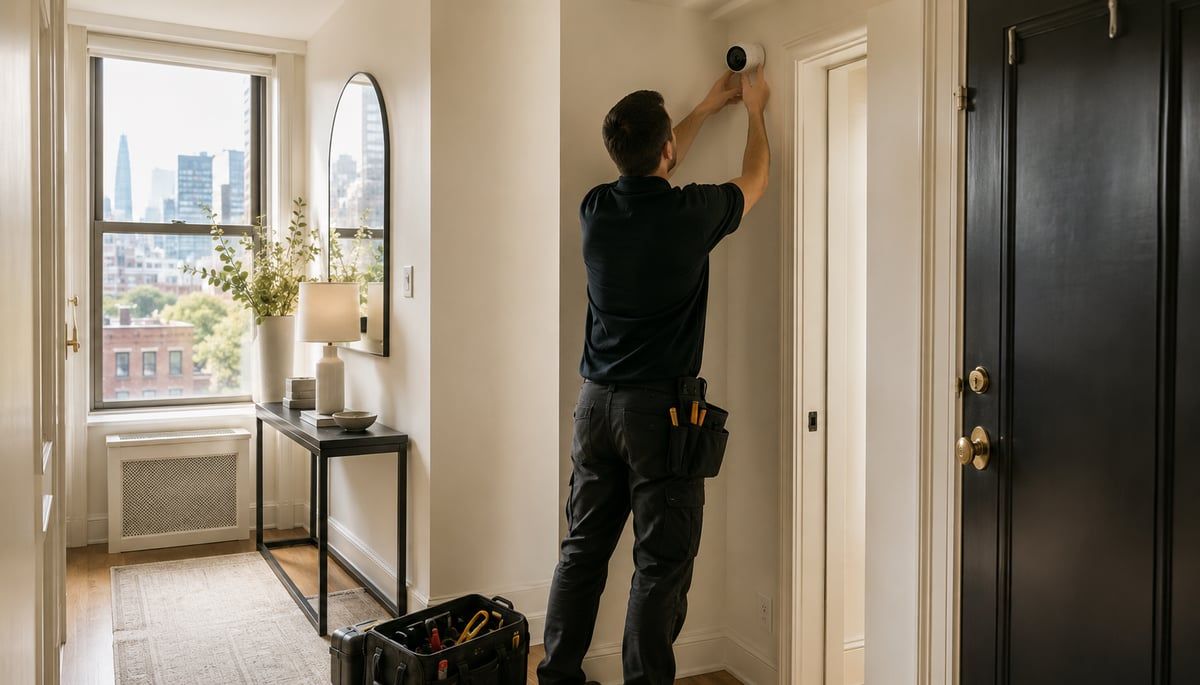
- 1A technician assesses your space (or does a virtual walkthrough) and recommends camera and sensor placement and system size.
- 2You choose between self-monitored and professionally monitored, and confirm exactly what is included in the installation quote.
- 3Installation day: wiring, camera and sensor mounting, control panel setup, and connecting the system to power and your network.
- 4The installer walks you through the app or panel, tests every camera and sensor, and confirms monitoring is active if you chose it.
- 5You get documentation: warranty terms, the monitoring contract if any, and the installer's license information.
How to vet a security installer before you hire
This is one category where checking credentials matters more than almost any other home service, since you are handing someone real access to the system meant to keep your home secure.
New York requires a state Security or Fire Alarm Installer license for installing, maintaining, or servicing a security system, and that requirement explicitly covers cameras, not just alarms: under 19 NYCRR 195.2, a CCTV or video surveillance system needs a licensed installer if it is used, even part-time, for detecting or monitoring intrusion, break-in, or movement, which covers the overwhelming majority of real home security camera systems. The same regulation does carve out a genuine exception: a property owner installing a system on their own property, using their own labor, does not need this license themselves, though that says nothing about whether they should attempt the wiring and configuration on their own.
- Confirm the installer holds an active NY State Security or Fire Alarm Installer License from the Department of State. This is a real, state-level license specific to this trade, not a general home-improvement credential.
- Ask for proof of general liability insurance, and about the background-check policy for technicians who will be inside your home.
- Get the scope in writing: exact equipment (make and model), the number and placement of cameras or sensors, whether monitoring is included and for how long, and the total, not just a per-camera price.
- Ask what happens to your footage or data: where it is stored, who can access it, and how long it is retained.
- Many lead-generation sites treat "verified" as little more than a paid listing fee, not an actual license check. ServHom's license verification is pulled from a public record, not a badge a business paid to display.
Finding a security installer you can trust
Once you know what a fair price looks like and what license to check for, the next challenge is actually finding an installer who is accountable, not just first to answer the phone. Most ways to find one either sell your contact details to a list of companies who all reach out at once, or rank whoever pays the most for placement.
ServHom does neither. No security installer can pay to rank higher on ServHom, ever, and we surface the trust signals we have on file so you can compare installers on something other than who called first.
How to use this before you hire
Use the checks in this guide no matter who you end up hiring. When you are ready to compare providers directly, ServHom shows source-labeled business facts and money-blind ranking for NYC pros, so you can see why a business is listed, not just that it is.
FAQ
How much does it cost to set up a home security system?
It depends mainly on whether you choose cameras, a monitored alarm, or both. A basic monitored alarm commonly runs $130 to $300 installed; a fuller professionally monitored system runs $300 to $1,238, averaging around $746. A basic camera system runs $500 to $1,000, and a fuller multi-camera setup runs $1,500 to $4,000.
How much does an alarm system cost for a 3 bedroom house?
There is no single number tied to bedroom count alone, since the real driver is how many doors, windows, and other entry points you want covered, not square footage. For a typical 3-bedroom home, a fuller monitored system with multiple door and window sensors commonly lands in the $300 to $1,238 range noted above, toward the higher end if you add cameras.
What security system do burglars hate?
Visible deterrents matter as much as invisible ones. Clearly visible cameras and yard or window signage, loud on-premise alarms, and professionally monitored systems that trigger a real response are the most commonly cited deterrents, since most burglars are looking for an easy, unnoticed entry, not a confrontation.
Can I install security cameras myself?
Legally, yes, in one specific case: New York's licensing rule (19 NYCRR 195.2) exempts a property owner installing a system on their own property using their own labor. That is a legal exemption, not a recommendation, wiring, camera placement, and getting monitoring or motion detection actually working correctly is real, technical work, and a self-install mistake is exactly what a professional installer is there to avoid.
Do I need internet for a security system?
For most of what people expect from a modern system, yes. Remote viewing on your phone, push alerts, cloud recording, and professional monitoring in many systems all rely on an internet connection. Some systems offer a cellular backup for when the internet or power goes out, worth asking about specifically if that reliability matters to you, rather than assuming every system has it.
Where is security camera footage stored?
Either locally, on an on-site recorder (an NVR or DVR) you own, or in the cloud through a subscription the provider manages. Local storage has no ongoing fee but is only as safe as the physical device, cloud storage usually costs a recurring subscription but survives if the on-site hardware is damaged or stolen. Ask your installer which one your system uses and how long footage is actually retained before it is overwritten.
Can you move security cameras to a new home?
It depends on the type. Wireless or battery-powered cameras are usually straightforward to unmount and reinstall elsewhere. A hardwired system professionally installed into your walls is harder to relocate, since the wiring itself does not move with you, and a monitored alarm contract may need to be addressed separately with the provider when you move. Ask about this before you sign if you expect to relocate before the system would otherwise pay for itself.