NYC price guide
How Much Does French Drain Installation Cost in NYC?
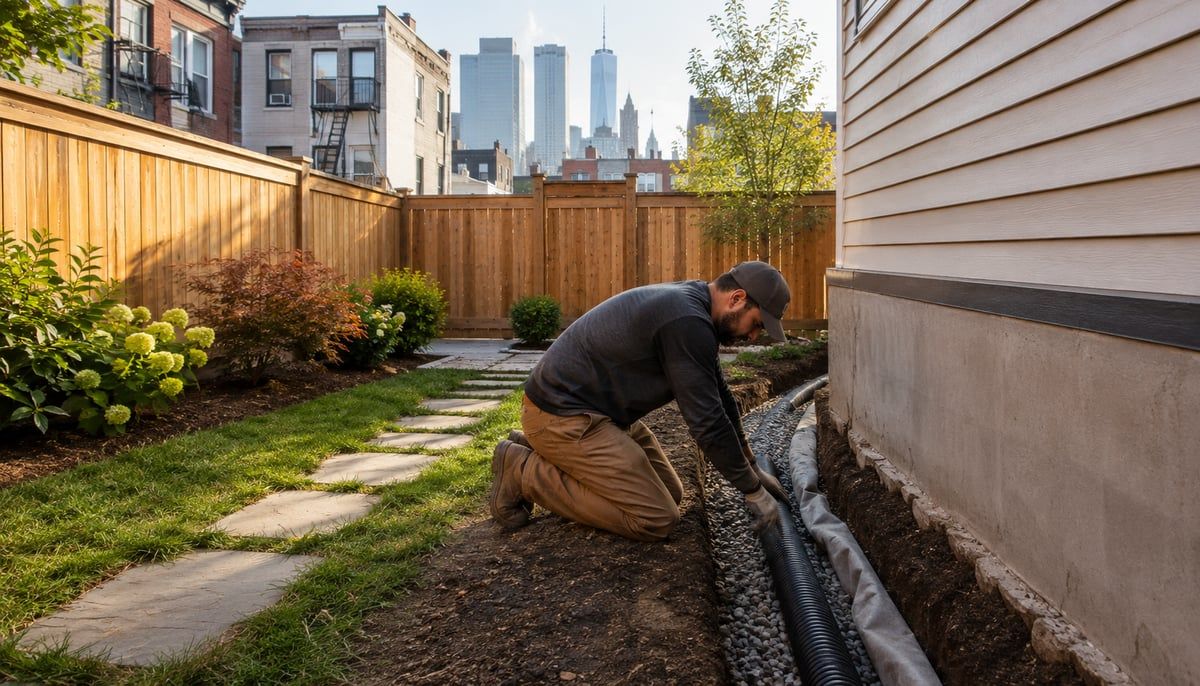
A wet basement or a yard that never drains after rain is miserable, and a French drain sounds like the obvious fix. It is, but NYC has a real rule about where that water is actually allowed to end up, and it is not your neighbor's yard or the sidewalk. Here is what installation actually costs, and the question to ask before anyone starts digging.
Quick Takeaways
- Professional French drain installation commonly runs $10 to $75 per linear foot, with most full NYC-area projects landing between $1,650 and $12,250 depending on length, depth, and where the water needs to be routed.
- NYC's Plumbing Code explicitly prohibits site grading or drainage work that causes storm water to flow across a sidewalk or onto an adjacent property. A French drain that just redirects your water problem onto a neighbor's yard is not a legal fix, it is a future dispute.
- NYC code generally requires added impervious surface, like a new patio, to drain into a storm sewer, combined sewer, or approved disposal point. A narrow exception exists for existing one- or two-family homes where a proposed building enlargement plus any added impervious surface together total 200 square feet or less, so a small hardscaping addition on its own may not change what your drainage plan needs to do.
- Short, small-scope French drain jobs often carry a real minimum charge that pushes the effective per-foot cost well above the broader national per-foot rate, which is why a 25-foot job can cost as much per foot as a much longer one.
- Ask a contractor specifically where the water is being routed to before work starts. "Away from the house" is not a complete answer if it just means onto the property next door.
The question a French drain quote should answer, and usually does not
A soggy yard or a basement that gets damp every time it rains is the kind of problem that makes a French drain sound like an obvious yes. Dig a trench, add a perforated pipe and gravel, let gravity do the rest. The part most quotes skip over is the actual finish line: where does all that redirected water go once it leaves your property. In a dense NYC lot, that is not a minor detail, it is a real legal question.
What French drain installation actually costs in NYC
Professional installation is typically priced per linear foot, and the real range is wide because depth, soil conditions, and how far the water has to travel all move the number.
Multiple national cost guides converge on $10 to $75 per linear foot for professional installation. For a full project rather than a single quoted rate, real NYC-area pricing data puts most homeowners between $1,650 and $12,250 depending on scope.
Short, small-scope jobs often do not scale down proportionally. Real homeowner-reported quotes for a roughly 25-foot shallow drain have run $1,500 to $2,200, well above what the per-foot national rate alone would suggest, which points to a real minimum trip and setup charge that applies regardless of how short the run is.
- Per linear foot, professional installation: $10 to $75.
- Typical full project, most NYC-area homeowners: $1,650 to $12,250.
- Short spot-fix runs (around 25 feet): $1,500 to $2,200 in real reported quotes, reflecting a minimum charge rather than the per-foot rate alone.
Cost by scenario
These two ranges are not mutually exclusive job sizes, they are two different real reference points from the sources reviewed, August 2026. A short spot-fix run often costs more per foot than a longer project due to a minimum trip and setup charge.
Professional installation is also commonly priced at $10 to $75 per linear foot, a different unit not shown on this chart since it cannot be honestly compared to a total-project dollar figure on the same axis.
Where NYC law says that water can and cannot go
This is the part a landscaper's price list will not mention, and it is a real, checkable rule, not a guideline.
- NYC's Plumbing Code (Section 1101.12, Site Grading) prohibits site grading or land contour work that would cause storm water to flow across sidewalks or onto an adjacent property. A drainage design that sends water toward the property line or the public sidewalk can violate this rule, so the outlet location needs to be addressed before work begins, not treated as a minor detail.
- Separately, NYC code generally requires any increase in impervious surface, like a new patio or walkway, to drain into a storm sewer, combined sewer, or another approved place of disposal. There is a narrow exception for existing one- or two-family homes: if a proposed building enlargement plus any added impervious surface together total 200 square feet or less, existing facilities may be allowed to handle the drainage instead. If your project combines drainage work with new hardscaping, that combined total, not just the patio alone, is what determines whether the exception applies.
- Ask directly where the outlet point is and what it connects to: a dry well on your own property, an approved storm connection, or something else. "It drains away from the foundation" answers a different question than "where does it end up."
- A neighbor dispute over redirected water is one of the most common real complaints in this category, and it is also one of the easiest to avoid by asking this one question before the trench gets dug.
Do you actually need a French drain
A French drain is a real fix for a specific kind of problem, not the default answer to every wet yard or damp basement. Before paying for one, it is worth confirming the diagnosis matches the tool.
- Water pooling near the foundation, away from any obvious downspout or slope issue: a French drain is often the right call.
- A downspout that dumps water right at the foundation: often just needs a downspout extension, a much cheaper fix than a full drain.
- Surface water running toward the house because of the yard's slope: sometimes solved with regrading alone, before any pipe goes in the ground.
- A catch basin or existing drain that has simply stopped working: may just need cleaning or repair, not a brand new system.
- Persistent groundwater or a recurring wet basement even after surface fixes: can point to a more specialized waterproofing or foundation drainage problem beyond what a yard-level French drain addresses.
| Symptom | More likely fix |
|---|---|
| Water collects near the foundation, no obvious cause | French drain |
| Downspout discharges right at the foundation | Downspout extension |
| Surface water runs toward the house from a slope | Regrading |
| An existing catch basin or drain is clogged | Drain cleaning or repair |
| Wet basement persists after surface fixes | Waterproofing or specialized drainage assessment |
What actually drives the price
Two French drain jobs that sound similar on the phone can land on very different quotes once the crew actually looks at the yard.
- Where the water has to go: connecting to an existing storm sewer, digging a dry well, or routing water further from the house all cost differently, and some outlet points are simply not legal options depending on where they would discharge. This is usually the single biggest factor, not just how long the trench is.
- Length and depth: a longer run or a deeper trench (needed for some soil and slope conditions) adds real excavation time and material.
- Soil and access: rocky soil, tree roots, or a yard with limited equipment access all slow the dig and raise labor cost.
- Whether it is a repair to an existing failed system or a new installation: diagnosing why an old French drain stopped working can add real time before any new digging starts.
- Surface restoration: digging through an existing lawn, paver patio, or planting bed means putting it back afterward, and restoring pavers or concrete costs meaningfully more than reseeding a patch of grass.
How to vet a pro for drainage work specifically
Drainage work is easy to underprice on a quick phone quote and then renegotiate once the crew is on site. A few specific questions help avoid that.
- Ask exactly where the water outlet is planned and get it in writing. A vague answer here is the single biggest red flag in this category.
- Ask whether the quote includes fixing any resulting damage to the lawn, patio, or existing landscaping once the trench is filled back in. This is a common source of disputed change orders.
- For a co-op, condo, or shared-lot situation, confirm who actually has authority to approve drainage work before it starts, since a French drain on shared property is a different conversation than on a single-family lot.
- On any lead-generation marketplace, a "verified" badge is often just a paid listing fee, not a real check on licensing or past work. Money-blind ranking means no business can pay to appear higher in results, on ServHom or anywhere it operates that way, so what you see reflects real signals, not who paid the most.
Finding someone you can actually trust with this
Once you know the real cost range and the legal question most quotes skip, the next challenge is finding a landscaping or drainage pro who can actually diagnose the problem and answer that question before starting work, not just dig a trench.
On many lead-generation marketplaces, the same request gets sent to several competing companies at once, and the homeowner has no real way to check who is actually reliable before the calls start coming in. ServHom takes a different approach: you see real, ranked landscaping businesses with their information shown up front, and you review and choose who to contact yourself.
How to use this before you hire
Use the checks in this guide no matter who you end up hiring. When you are ready to compare providers directly, ServHom shows source-labeled business facts and money-blind ranking for NYC pros, so you can see why a business is listed, not just that it is.
FAQ
How much should it cost to put in a French drain?
Professional installation typically runs $10 to $75 per linear foot, with most full NYC-area projects landing between $1,650 and $12,250 depending on length, depth, and where the water is routed. Short spot-fix jobs often cost more per foot than longer runs due to a minimum trip and setup charge.
Are French drains worth the money?
For a yard that floods regularly or a basement with recurring water intrusion, a properly installed and legally routed French drain is generally worth it compared to repeated water damage. The value depends heavily on the water actually being routed somewhere legal and effective, not just moved a few feet away from the foundation.
What is the lifespan of a French drain?
A well-designed, properly installed French drain can last decades, but there is no single universal lifespan figure. Soil conditions, sediment buildup, root intrusion, pipe and fabric quality, and how well the system was designed for the site all affect how long it stays effective, and a system with proper filtration fabric generally holds up longer than one without it.
How much is a 50 foot French drain?
At the commonly cited $10 to $75 per linear foot range, 50 feet works out to roughly $500 to $3,750 before accounting for project-specific minimums, excavation conditions, outlet work, and surface restoration. Given that short jobs often carry a real minimum charge, a real NYC quote for 50 feet can land meaningfully above the simple per-foot math, not at the low end of that range.