NYC homeowner guide
How to Check if a Plumber Is Licensed in NYC
What the license actually means, which credentials are real, and how to confirm any plumber with the city yourself in about two minutes.
Quick Takeaways
- In NYC, real plumbing work has to be done under a Licensed Master Plumber (LMP), licensed by the NYC Department of Buildings (DOB).
- A Master Plumber license is the baseline. Gas work often needs an extra, separate credential, and NYC has more than one kind, so ask exactly which one applies to your job.
- You can confirm any plumber license yourself on NYC.gov in about two minutes. Never take a badge on a website as proof.
- A license shows accountability and code knowledge, not that the price is fair or the work is great, so still compare and get it in writing.
- Walk away from anyone who will not give a license number, refuses a written scope, or wants a large cash deposit up front.
1. Why "licensed" actually means something in NYC
A plumber can say they are licensed in about two seconds. Whether that is actually true, whether the plumber is genuinely legit, takes a little longer to check, but in NYC you can do it yourself. In New York City, plumbing is permit-sensitive and safety-sensitive work, so a license is not a formality. A licensed plumber is accountable to a city agency, can pull the permits the job needs, and is expected to work to code. If something goes wrong, you have a real avenue for recourse.
Unlicensed plumbing or gas work can do the opposite. It can fail inspection, complicate insurance claims, create safety hazards, and cause problems when you sell or refinance. The license is the first thing that separates a real business from a risk.
- Licensed work can be permitted and inspected by the city.
- The licensee is accountable to a city agency, not just to a review site.
- You have recourse if the work is unsafe or never finished.
- Unlicensed gas or plumbing work can complicate insurance claims and create resale problems.
2. Do you need a licensed plumber for a simple leak or repair?
Usually yes, and this is exactly where homeowners get tripped up. NYC treats two separate questions, "does this job need a permit" and "does this job need a licensed plumber," as two different questions with two different answers. A permit is a separate approval that DOB issues for a specific job. A license is a credential the plumber, or the master plumber supervising the work, actually holds. You can need one without the other.
Under NYC Administrative Code 28-105.4.4, "ordinary plumbing work", most everyday repairs, like fixing a leak, replacing a valve, or repairing existing pipe, do not require a permit. But DOB is explicit that the work itself still has to be performed by a Licensed Master Plumber or someone working under one. No permit does not mean no license.
- A dripping pipe under the sink or a leaking shutoff valve: ordinary plumbing work, no permit needed, but still a licensed plumber's job.
- Replacing a worn washer or a faucet without touching the supply lines: sometimes handled as a simple fixture repair under general home improvement work instead.
- A burst pipe or a gas leak: emergency work. A licensed contractor can start right away, then must file an Emergency Work Notification with DOB within two business days.
- Adding, moving, or replacing pipe, drains, or gas lines: ordinary plumbing work at minimum, always a licensed plumber's job.
3. What about a renovation, big or small? Do you need a licensed plumber?
Almost always yes for the plumbing part, no matter the size of the renovation. NYC has a specific category for this called Limited Plumbing Alteration (Admin Code 28-101.5), and the rule is explicit: this work can only be performed by a Licensed Master Plumber. What changes with the size of the job is whether you also need an architect or engineer to file plans, not whether you need a licensed plumber.
Limited Plumbing Alteration splits into two tiers. One is capped at $35,000 per building in any 12-month period and covers things like adding up to five new fixtures or connections, or installing new piping. The other has no cost cap and covers rerouting existing pipe to the same number of fixtures, in-kind fixture replacement beyond an ordinary repair, and relocating existing fixtures on existing roughing. Either tier still has to be a Licensed Master Plumber. If the renovation goes beyond both tiers, a Registered Design Professional (architect or engineer) has to file full construction plans before a permit is issued, and the plumbing work itself is still a Licensed Master Plumber's job either way.
- Small: a vanity or sink swap onto the same existing connections, or a few new fixtures under $35,000 in a 12-month period. A Limited Plumbing Alteration, still needs a Licensed Master Plumber.
- Small to mid-size: relocating an existing fixture onto its existing roughing, like shifting a toilet a few inches during a bathroom refresh. Still a Limited Plumbing Alteration, still a Licensed Master Plumber's job.
- Big: adding a new bathroom, moving plumbing into a new part of the layout, or combining two bathrooms. This usually exceeds a Limited Plumbing Alteration, so a Registered Design Professional must file plans, and the plumbing itself is still a Licensed Master Plumber's job.
- Electrical work in any renovation needs its own separately licensed NYC electrical contractor, filed under its own permit.
- For larger plumbing alterations, a Registered Design Professional (architect or engineer) may need to file construction plans before a permit can be issued. Your licensed plumber should tell you what filing and permit path applies to your specific project.
- NYC's construction rules are also time-sensitive. The city's new Existing Building Code applies to alteration applications filed on or after July 17, 2027; before that date, the 2022 NYC Construction Codes still govern. Confirm the current rule for your actual filing date rather than assuming.
4. The credential that matters most: the Master Plumber (LMP) license
In NYC, plumbing work must be performed or supervised by a Licensed Master Plumber (LMP). Registered journeymen and employees can do the hands-on work, but it has to be under the direct and continuing supervision of an LMP, per the NYC Department of Buildings journeyman plumber registration requirements. The license is issued by the NYC Department of Buildings (DOB) and carries a number, for example License #2384. When people search for a "master plumber license," this is what they are really checking.
A company you call may employ many people, but the plumbing work runs under one licensed master plumber who stands behind it. So you are not just hiring a brand, you are relying on a specific licensed person and their record.
- Ask for the Master Plumber name and license number before you book.
- The license should be active, not expired or revoked.
- One master plumber can be accountable for an entire company.
- For gas work, the master plumber license plus a gas qualification both matter.
5. DOB vs DCWP: check the right agency
Two different NYC agencies license home trades, and homeowners check the wrong one all the time. The NYC Department of Buildings (DOB) licenses plumbers and electricians. The Department of Consumer and Worker Protection (DCWP, formerly the DCA) licenses Home Improvement Contractors and many consumer services.
A plumber license lives with DOB, so that is where you confirm it. Checking DCWP for a plumber, or DOB for a general remodeler, is a common reason a real license seems to "not show up."
- Plumber and electrician licenses: NYC DOB.
- Home improvement contractor and general remodeling: NYC DCWP.
- Checking the wrong agency is why a valid license sometimes cannot be found.
- A plumbing company that also sells broader renovation or home-improvement work may carry a DCWP Home Improvement Contractor license in addition to the DOB plumbing license.
6. Gas work has an extra layer of credentials, and they are not interchangeable
A Master Plumber license is the starting point, but NYC has more than one gas-related credential, and they cover different things. If the person actually doing the gas work is not themselves a Licensed Master Plumber, NYC requires them to hold a DOB Gas Work Qualification (Full or Limited) under Local Law 150 of 2016, working under an LMP's supervision. That is separate from "Gas Operator Qualified" (GOQ), an industry-administered credential covering Covered Tasks 86/87 that is tied specifically to Local Law 152 periodic gas piping inspections and tracked through groups such as the Northeast Gas Association and the Plumbing Foundation of New York. A plumber can hold one of these without the other. If gas work is part of your job, ask exactly which credential applies to what they are actually doing, rather than accepting "gas qualified" as one generic answer.
The same caution applies to association logos, manufacturer certifications, and awards. They can be genuine, but they are self-reported unless you can confirm them at the source. If a credential matters to your decision, ask for the source and the date it was issued.
- General gas work by anyone other than the Licensed Master Plumber generally requires a DOB Gas Work Qualification (Local Law 150 of 2016).
- Gas Operator Qualified (GOQ) is a narrower, separate credential tied specifically to Local Law 152 periodic gas piping inspections, not general gas work.
- These two gas credentials are not interchangeable. Ask which one actually applies to your job.
- Treat memberships, badges, and awards as extra context, not proof of a license.
7. NYC plumber license lookup: verify anyone yourself in about two minutes
You never have to just trust a badge on a website. A NYC plumber license lookup, sometimes called a master plumber license lookup, is a public record check anyone can run in a couple of minutes. NYC publishes the license records directly, and that is exactly what ServHom links to on each profile. Statuses can change, so the official site is always the final word.
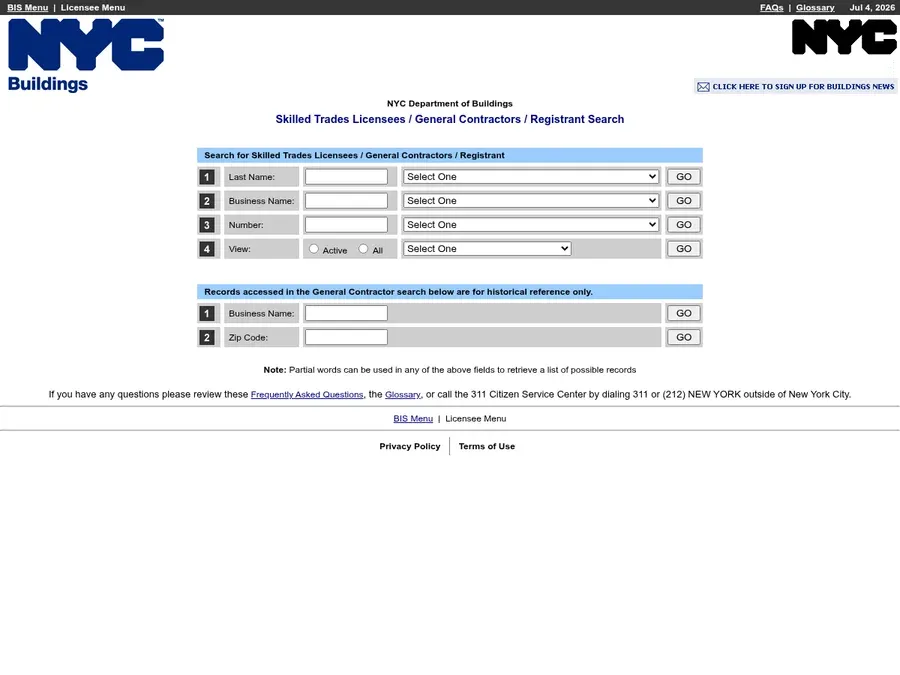
- 1Ask for the business name and the Master Plumber license number.
- 2Open the NYC DOB licensee search at a810-bisweb.nyc.gov and search by number or name.
- 3Confirm the license is active and the name matches who you are hiring.
- 4For home improvement or remodeling work, use the DCWP license search at a866-dcwpbp.nyc.gov instead.
- 5Ask for proof of general liability and, if your building requires it, a certificate of insurance (COI).
- 6Get the scope, materials, and price in writing before work starts, not after.
- 7If a credential is shown "as of" a date, treat that as a snapshot and confirm the current status at the official source.
8. Check the business, not just the license number
A Master Plumber license belongs to a person, not a company, so it is worth confirming the two actually match. Only a Licensed Master Plumber, or the employees they directly supervise, may legally work on piping systems, and NYC Administrative Code 28-401.18 requires the LMP to put their license number and business information on trucks, business cards, and advertisements. If the business cannot tell you which LMP is responsible for your job, that is worth pausing on.
- Ask for the name and license number of the specific Licensed Master Plumber responsible for the work, not just the company name.
- When the plumber arrives, check that the truck, invoice, or business card shows a business name and license number, and that it matches who you booked.
- If a company says it works under a different LMP than the one you were told, ask why before work starts.
9. How ServHom helps you validate a company in one place
A license is the most important check, but it is not the only signal worth looking at. ServHom profiles pull together the DOB license, linked to the official record, alongside other real signals where we have them: BBB accreditation, industry memberships such as the Master Plumbers Council, and Gas Operator Qualified status for gas work. You still get the same public facts, just gathered in one place instead of a search across several agency and industry sites.
This does not replace the official record, and coverage varies by business since not every company carries every signal. Where we show something, it links back to where it came from, so you can always confirm it yourself.
- License status, linked to the DOB record.
- BBB accreditation, where the business carries it.
- Industry memberships, such as the Master Plumbers Council of NYC.
- Gas Operator Qualified status for businesses that do gas work.
10. What helps you decide, and what does not
Not every trust signal carries the same weight. Some are verifiable facts, and some are just marketing. Sorting them keeps you from paying a premium for a logo.
- Helps: an active city license you can confirm, proof of insurance (and a certificate of insurance for co-op or condo work), a written scope and price, and recent, specific reviews.
- Helps less: a five-star average with no detail, a wall of logos, "we do everything," or "licensed and insured" with no number to check.
- Does not help: pressure to decide now, cash-only with no paperwork, or a quote with no breakdown.
11. Red flags worth walking away from
- Will not give a license number, or the number does not check out on NYC.gov.
- The license number belongs to a different person or business than who you are hiring.
- The business will not say which Licensed Master Plumber is responsible for the job.
- For gas work, nobody can tell you which gas credential actually applies.
- Wants a large cash deposit before any written agreement.
- Skips permits for work that clearly needs them, such as gas or major repairs.
- Refuses to put the scope, materials, and price in writing, or will only quote verbally.
- Uses door-to-door or phone pressure to make you sign immediately.
12. Questions to ask before you hire a plumber
- Who is the Licensed Master Plumber on this job, and what is the license number?
- Is this work permitted, and who pulls the permit?
- Do you carry general liability and workers compensation insurance, and can you provide a certificate of insurance (COI) for my building?
- Can I get the diagnosis, scope, and price in writing before we start?
- What warranty do you offer on parts and labor?
How to use this before you hire
Use the checks in this guide no matter who you end up hiring. When you are ready to compare providers directly, ServHom shows source-labeled business facts and money-blind ranking for NYC pros, so you can see why a business is listed, not just that it is.
FAQ
Do plumbers need a license in NYC?
Yes. In New York City, plumbing work must be performed or supervised by a Licensed Master Plumber, licensed by the NYC Department of Buildings, and gas work has additional requirements. This is not legal advice, so confirm specifics with the DOB or your building.
How do I check if my plumber is licensed?
Ask for the Master Plumber license number, then search it on the NYC DOB licensee search at a810-bisweb.nyc.gov. Confirm the license is active and the name matches who you are hiring. For home improvement contractors, use the DCWP license search instead.
What is a Master Plumber license?
A Master Plumber (LMP) license is the NYC credential that lets a plumber legally perform and stand behind plumbing work. It is issued by the NYC Department of Buildings and carries a number you can verify. A company may employ many workers, but the work runs under a licensed master plumber.
What does Gas Operator Qualified mean?
Gas Operator Qualified (GOQ) is an industry-administered credential covering Covered Tasks 86/87, tied specifically to NYC's Local Law 152 periodic gas piping inspections. It is a real, checkable qualification, but it covers a narrower job than general gas work, and it is not a New York City license, so treat it as a plus on top of the master plumber license, not a substitute for it.
Does a plumber need a separate qualification for gas work?
Often, yes. If the person actually doing the gas work is not themselves a Licensed Master Plumber, NYC requires them to hold a DOB Gas Work Qualification (Full or Limited) under Local Law 150 of 2016, working under an LMP's supervision. That is a different credential from Gas Operator Qualified (GOQ), which applies specifically to Local Law 152 inspections. Ask which one applies to your job.
Does a license guarantee good work or a fair price?
No. A license shows accountability and that the plumber is qualified to do the work legally, but it does not promise the lowest price or the best result. For non-emergencies, still compare more than one provider, read recent reviews, and get the scope and price in writing.
How much does a plumber cost in NYC?
It depends on the job, access, parts, and whether it is an emergency or a scheduled visit, so there is no single fixed number. Ask two or three licensed plumbers for an itemized written quote so you can compare like for like.
Is there a separate New York State plumbing license, or is it only a NYC license?
Plumbing licensing in NYC works at the city level, not the state level. The Master Plumber license is issued and searched through the NYC Department of Buildings, not a New York State board. If you are looking for a "New York State plumbing license," what you actually want is the NYC DOB licensee search described above. Outside NYC, licensing rules are set locally by each municipality, so confirm with the specific city or county involved.
Where do I look up a home improvement contractor license instead of a plumber license?
That is a different system. General home improvement contractors are licensed by the NYC Department of Consumer and Worker Protection (DCWP), not the DOB, so you search the DCWP license lookup instead of the plumber license search. A company that does both plumbing and general renovation work may hold a DOB plumbing license and a separate DCWP Home Improvement Contractor license, and each one is checked at its own agency.
Can I report an unlicensed plumber in NYC?
Yes. NYC 311 has a dedicated way to report work done by an unlicensed plumber, alongside separate options for unlicensed electricians, contractors, and home improvement contractors. If a business cannot produce a valid, matching license, you can file a report at 311.