NYC price guide
How Much Does Appliance Repair Cost in NYC?
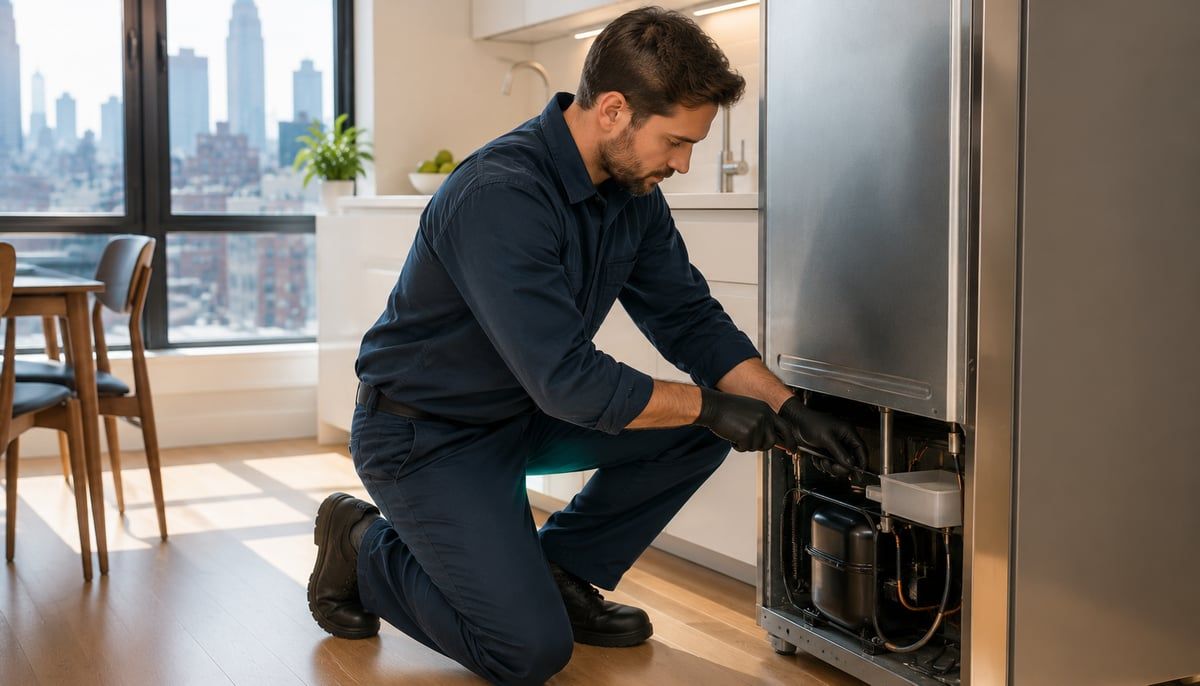
A tech quotes $280 to fix a fridge that is making a weird noise, and the real question isn't just whether that's fair, it's whether fixing it even makes sense. Here is the real range by appliance, and how to tell repair from replace.
Quick Takeaways
- A typical appliance repair visit in NYC runs $100 to $400 including labor and a basic part, or roughly $50 to $100 an hour, based on multiple independent national cost guides reviewed in July 2026. One NYC-specific cost aggregator puts the citywide average at $320 to $333.
- Refrigerator repairs run notably higher: most common issues fall between $200 and $600, while a full sealed-system repair (compressor and refrigerant) is a different tier entirely, commonly $1,200 to $1,800. Smaller appliances like dishwashers typically run lower, often $150 to $250.
- The 50/50 rule is a widely used guideline for the repair-or-replace decision: if the repair costs more than half of a comparable new unit, and the appliance is more than halfway through its expected lifespan, replacing it usually makes more financial sense.
- A technician working on a refrigerant-containing appliance (refrigerator, freezer, window AC) is legally required to hold EPA Section 608 certification. A dishwasher, oven, or dryer technician does not need this specific credential.
- Ask about the diagnostic or service call fee upfront, and whether it gets credited toward the repair if you proceed. This is one of the most common sources of quote confusion.
Is this quote actually fair
A technician comes out, listens to the fridge for thirty seconds, and quotes $280. Is that a fair price for whatever is wrong with it, or a number picked because there is no way to check? For anyone who is not a repair tech, there is no real reference point, and that is exactly the problem. A normal appliance repair quote and an inflated one can look identical on paper.
What appliance repair actually costs in NYC
Multiple independent national cost guides and marketplaces, reviewed in July 2026, converge on $100 to $400 per visit including labor and a basic part, or roughly $50 to $100 an hour. NYC tends to run at or above the middle of that range: one NYC-specific cost aggregator puts the citywide average at $320 to $333 per repair. If you are a renter and the appliance was provided by your landlord, NYC law generally makes the landlord responsible for repairing it, so it is worth checking your lease and asking your landlord before paying for a repair yourself.
- Refrigerators and freezers: most common repairs, like a door seal, ice maker part, or fan, fall between $200 and $600. Full sealed-system work (evaporator, compressor, and refrigerant recharge) is a different tier entirely, commonly $1,200 to $1,800, and requires an EPA-certified technician. Technicians sometimes recommend replacing more than one sealed-system part together, since a failure in one can shorten the life of the others nearby. Ask them to explain why each part is being replaced.
- Built-in luxury brands (SubZero, Miele, Wolf, Viking, and similar), common in NYC co-ops and condos, are a real exception to the ranges above: parts and specialized service can push a repair well past $1,000, and quotes in the thousands are not unheard of for a sealed-system issue. Ask for a written estimate before agreeing to anything on a high-end built-in unit.
- Dishwashers: typically on the lower end, roughly $150 to $250, for common issues like a pump, latch, or spray arm.
- Washers and dryers: generally fall within the general $100 to $400 range, lower for a belt, hose, or heating element, higher if a drum or motor needs replacing.
- Diagnostic or service call fee: real reported rates range roughly $50 to $175 for a standard appliance, sometimes higher for a luxury built-in brand. This is sometimes credited toward the repair cost if you proceed and sometimes not. Ask before booking, not after.
Is it even worth repairing, or should you replace it
This is usually the more useful question, and it comes up in real searches almost as often as the cost question itself. A widely used guideline for this decision is the 50/50 rule.
- The 50/50 rule: if the repair estimate is more than 50 percent of the cost of a comparable new appliance, and the appliance is more than halfway through its typical lifespan, replacing it usually makes more financial sense than repairing it.
- Below that threshold, repair is typically the cheaper option, especially for a newer appliance or a simple, well-understood fix.
- Age and part availability matter beyond the raw percentage: an older or discontinued model can mean a longer wait for parts and a real chance the same part fails again soon after, which is worth weighing even when the repair itself is technically the cheaper number.
- Get a second opinion before accepting a quick "not worth fixing" verdict, especially if the diagnosis felt rushed or vague. A diagnostic visit is inexpensive relative to a major repair or a new appliance, so a second, more thorough look costs little given the size of the decision.
- Typical appliance lifespans, based on multiple independent appliance guides reviewed in July 2026: refrigerators and freezers 10 to 15 years, washers and dryers 10 to 14 years, dishwashers 9 to 12 years, and ranges or ovens 13 to 15 years. Compare your appliance's age against these to gauge the second half of the 50/50 rule.
- Repairs that are usually worth making: a door seal, a belt, a heating element, a water inlet valve, or an igniter. These are common, well-understood fixes on most appliances.
- Repairs that often make more sense to replace instead: a failed compressor, a sealed refrigerant leak, multiple control boards failing at once, a rusted drum, or a cracked tub. These tend to be structural or point to a unit near the end of its life.
What actually drives the price
Two quotes for what appears to be the same problem can still differ by a lot. The biggest price drivers are usually these.
- Appliance type and the underlying problem: an electrical or control-board issue is generally more involved than a mechanical part like a belt or hose.
- Whether the appliance contains refrigerant: refrigerator, freezer, and window AC repairs that touch the sealed system legally require an EPA Section 608 certified technician, which is a real cost and availability factor a dishwasher or dryer repair does not have.
- OEM parts requirements: many repair companies are contractually required by the manufacturer to use original parts rather than a cheaper generic equivalent to remain part of that brand's authorized service network. This is a real structural reason a quote can look high next to a part you could find yourself online, not automatically a sign of a markup scam.
- Age and part availability: parts for an older or discontinued model can be harder to source, which adds time and sometimes a markup. Some repair professionals report longer part wait times on certain brands, so it is worth asking upfront how available parts are for your specific model.
- Timing: evening, weekend, or same-day emergency service typically costs more than a scheduled weekday visit.
How to find someone reputable, not just cheap
The lowest quote is not automatically the best one, and appliance repair has the same lead-marketplace problem as other home services: a "verified" badge on a lead-generation site is often just a paid listing fee, not a real check on who is actually showing up at your door.
- For refrigerator, freezer, or window AC repair specifically, ask if the technician holds EPA Section 608 certification, the real federal requirement for anyone working on equipment that could release refrigerant.
- Ask whether the company is bonded and insured, and ask for proof, not just a verbal yes. In a co-op or condo, a company that resists filling out the building's certificate of insurance correctly, or pushes to come after hours or on weekends when your building does not allow it, is a real red flag worth taking seriously. Note that several large appliance retailers will not take on co-op jobs at all once building-specific insurance paperwork is required, so co-op residents specifically may need to look past the big-box option to find someone who regularly handles that paperwork.
- Get the diagnostic fee and how it applies to the final bill in writing before the technician arrives, not after the visit.
- Be skeptical of a search result that looks local but is not. Some businesses that appear local online are actually referral services or call centers that dispatch the job elsewhere. Look for a real, verifiable business address and specific, recent reviews, not just a local-sounding phone number.
- Read a handful of specific, recent reviews rather than trusting a star average alone. A wall of generic five-star reviews with no detail is itself a signal worth noticing.
Finding someone you can actually trust with this
Once you know what a fair price looks like and whether repair makes sense at all, the next challenge is actually finding a provider who meets that bar.
On many lead-generation marketplaces, the "verification" homeowners see is just a company that paid a listing fee, not a real background or license check, and some homeowners have reported ending up connected to a lead with a disconnected phone number or a company with real problems in its history. ServHom takes a different approach: you see real, ranked appliance repair businesses with their information shown up front, and you review and choose who to contact yourself rather than being blindly matched to whoever paid for the lead.
How to use this before you hire
Use the checks in this guide no matter who you end up hiring. When you are ready to compare providers directly, ServHom shows source-labeled business facts and money-blind ranking for NYC pros, so you can see why a business is listed, not just that it is.
FAQ
How much do appliance repair technicians charge?
Most NYC appliance repair companies charge $50 to $100 an hour, though many quote a flat per-repair price instead of a straight hourly rate. A typical service visit runs $100 to $400 total including labor and a basic part, with NYC often landing at or above the middle of that range.
Is it worth getting appliances repaired?
It depends on the repair cost relative to a new unit. A widely used guideline is the 50/50 rule: if the repair costs more than 50 percent of a comparable new appliance, and the unit is more than halfway through its typical lifespan, replacing it is usually the better value. Below that threshold, repair is typically the cheaper option.
How much does it cost to fix a dryer?
A dryer repair in NYC typically falls within the general $100 to $400 range, on the lower end for a common issue like a broken belt or heating element, higher if the drum or motor needs replacing.
What is the most expensive thing to fix on a refrigerator?
Problems with the sealed refrigeration system, the compressor or a refrigerant leak, are typically the most expensive refrigerator repairs, since that work legally requires an EPA-certified technician and can approach the cost of a new unit. Simpler fixes like a door seal or ice maker part cost far less.
What is the 50/50 rule for appliances?
The 50/50 rule is a guideline for the repair-or-replace decision: if the repair estimate is more than 50 percent of the cost of a new comparable unit, and the appliance is more than halfway through its typical lifespan, replacing it usually makes more financial sense than repairing it.